By: Jeff Hirz
A Google core update can feel like the ground moved under your website. Rankings that looked stable can slip. Traffic can fall even when the site is technically live and unchanged. Search results can also look different because featured snippets, People Also Ask results, AI Overviews, and other search features shift around the same time.
That does not mean Google penalized your site. A broad core update is a reassessment of how Google’s ranking systems evaluate content across the web. Some pages move down, some move up, and some hold position while click behavior changes around them.
The work after a core update is diagnosis. Confirm the update window, compare the right dates, look at affected pages and queries, rule out technical problems, and then improve the pages that actually lost visibility.
If you track Google SEO updates, treat a confirmed core update as a diagnostic window, not a blanket reason to rewrite every page.

What Is a Google Core Update?
A Google core update is a broad change to Google’s search ranking systems. Instead of targeting one site or one technical issue, a core update can change how Google evaluates many pages across many topics. The goal is to improve search results, so pages can rise, fall, or stay stable after the rollout.
Google makes many smaller changes to Search over time, but broad core updates are the ones most site owners notice. They can affect rankings, impressions, clicks, featured snippets, and the mix of pages that Google sees as most helpful for a query.
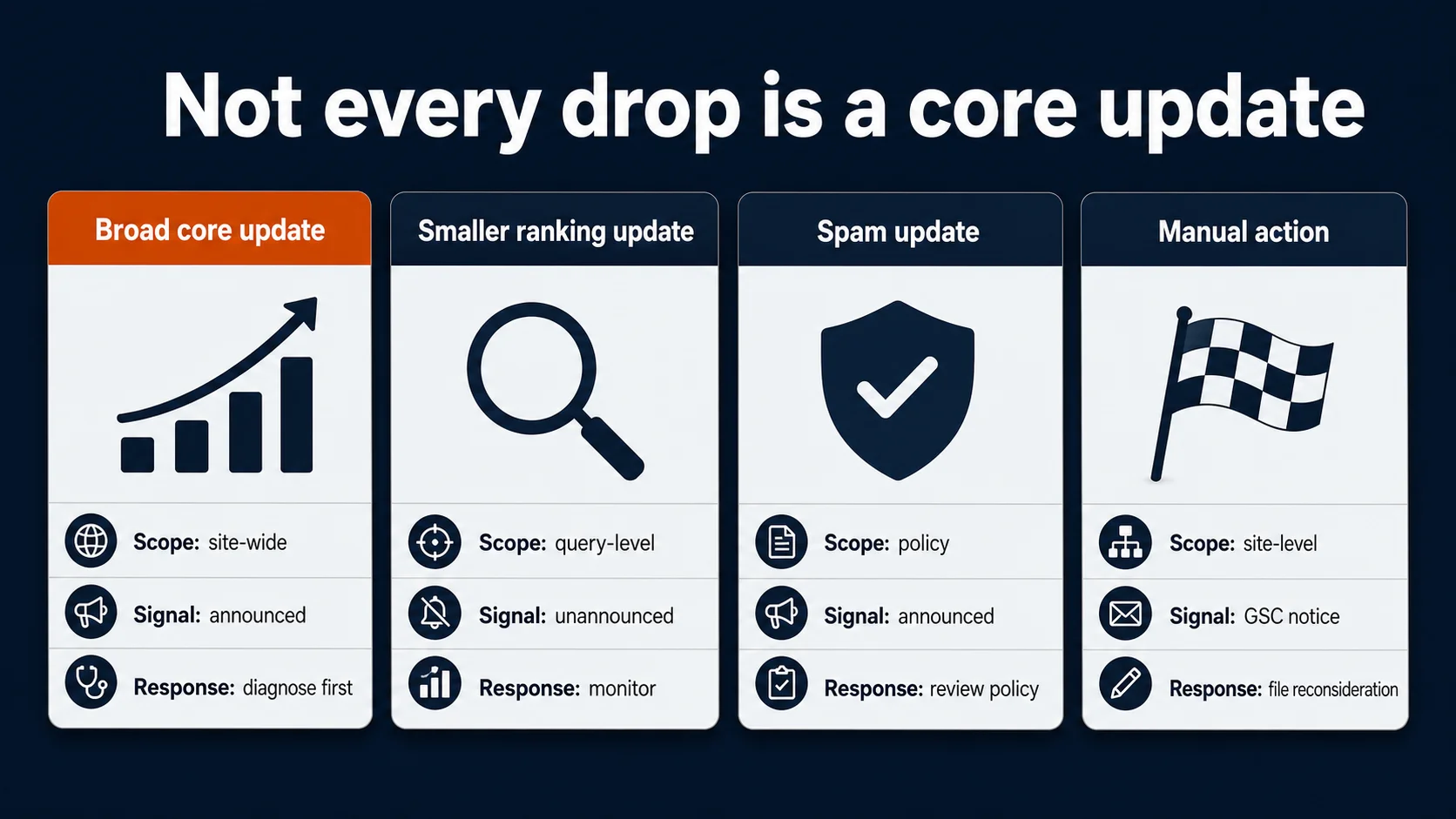
The important word is “broad.” A core update is not the same thing as a manual action, a security issue, or a spam penalty. If your rankings drop during a core update, Google is not necessarily saying your site broke a rule. It may be saying that other pages now look more useful, more current, more original, or more trustworthy for the searches where you used to perform well.
That is why core-update recovery starts with evidence, not assumptions. The question is not only “what did Google change?” The better question is: which pages and queries changed for your site, and what does that reveal about quality, relevance, trust, and search intent?
Core Updates vs. Smaller Google SEO Updates
Google Search changes constantly. Some changes are small, unannounced ranking adjustments. Some affect specific systems or search features. Broad core updates are different because Google confirms them publicly and tracks their rollout in the Google Search Status Dashboard.
For SEO teams, that distinction matters. If one page drops for one query on a random Tuesday, a broad core update may not be the cause. A competitor may have improved its page. Search demand may have shifted. A technical issue may have blocked a template. Google may also be testing or adjusting one feature in the results.
When Google confirms a core update, use that official window as your starting point. Do not compare random days or react to the first volatile report you see. Google recommends waiting until the update finishes, then waiting at least one full week before drawing conclusions from Search Console data.
Third-party tools can add context. Semrush Sensor, for example, tracks Google SERP volatility based on daily ranking changes and can show when search results are unusually active. But a volatility monitor cannot prove that your site was affected. It only tells you the wider results were moving.
That is where many teams lose the thread. They see a volatile day, match it to a ranking drop, and treat correlation as diagnosis. A core-update window should start the investigation, not end it. The stronger question is whether the affected URL, query group, country, device, and search type all point to the same story.
Recent Google Core Updates: March 2026 in Context
The March 2026 Google core update is the timely reason many businesses are revisiting this topic. According to Google’s Search Status Dashboard, the March 2026 core update began on March 27, 2026 and completed on April 8, 2026.
That broad core update followed the March 2026 spam update and a February 2026 Discover update, both of which Google also listed in its Search Status Dashboard history. That sequence is useful context, but it should not be stretched into a causal claim. A Discover update is not the same thing as an ordinary web-ranking update, and Google did not say those events were one coordinated wave.
What we can say safely is this: March 2026 created a fresh diagnostic moment. Search Engine Land’s April 2026 analysis, citing third-party data and commentary from Aleyda Solis, described a pattern where visibility often moved away from more interchangeable intermediary pages and toward clearer destination sources. That is industry analysis, not Google’s official explanation, but it lines up with what many SEO teams were seeing in the field.
OuterBox’s internal read was similar. Pages with thin, template-like, or mostly intermediary value were more exposed than pages with direct answers, first-hand expertise, stronger author trust, and clear business relevance. That does not mean every drop had the same cause. It does mean core-update recovery should focus on making the page a better destination, not just changing a few tags.
That destination-value idea matters for normal articles too. A page about Google updates should not only repeat that updates happen. It should help a reader decide what to check first, which data to trust, which changes are premature, and where real improvement is likely to come from. If the page cannot help with those decisions, it is easier for Google to prefer a result that can.
How Google Core Updates Affect SEO
Core updates affect SEO by changing which pages Google considers most useful for a search. The visible result may be a ranking drop, but the underlying pattern can be more specific than a single average-position number.
A page may lose rankings for broad queries while holding long-tail terms. It may keep its top keyword but lose many secondary queries. It may rank in roughly the same spot while a new SERP feature changes click-through behavior. It may lose a featured snippet, get pushed below an AI Overview, or see People Also Ask results absorb more attention.
This is why a core update should not be analyzed from one dashboard tile. Search Console, analytics, ranking data, and page-level review all tell different parts of the story. Search Console shows queries, impressions, clicks, countries, devices, and average position. Analytics shows what those visitors did after they landed. Ranking tools show competitive movement. The page itself shows whether the content still deserves to rank.
If your SEO services program is built around only raw rankings, a core update can look mysterious. If it is built around pages, queries, intent, technical access, internal links, content quality, and conversion, the update becomes easier to diagnose.
The strongest response is not to ask, “How do we get the old ranking back?” It is to ask, “What does Google now seem to reward for this query, and does our page still deserve to be one of the best answers?”
This is also why AI Overviews and other search features belong in the analysis without becoming the whole story. Google says generative AI features in Search are rooted in core Search ranking and quality systems. If an AI Overview appears for a query, the page may still need the same fundamentals: crawlable content, unique value, clear sourcing, and a useful answer. The presentation changed, but the page still has to earn trust.
How To Tell Whether a Google Core Update Affected Your Site
Start with the official update window. Google’s core update guidance says to confirm that the rollout has finished, wait at least a full week, then compare the right time periods. For the March 2026 update, that means comparing performance after April 8 against the week before March 27, not cherry-picking the most dramatic day.
Use this workflow:
- Confirm the update on the Search Status Dashboard.
- Wait at least one full week after completion.
- Compare the week after completion with the week before rollout began.
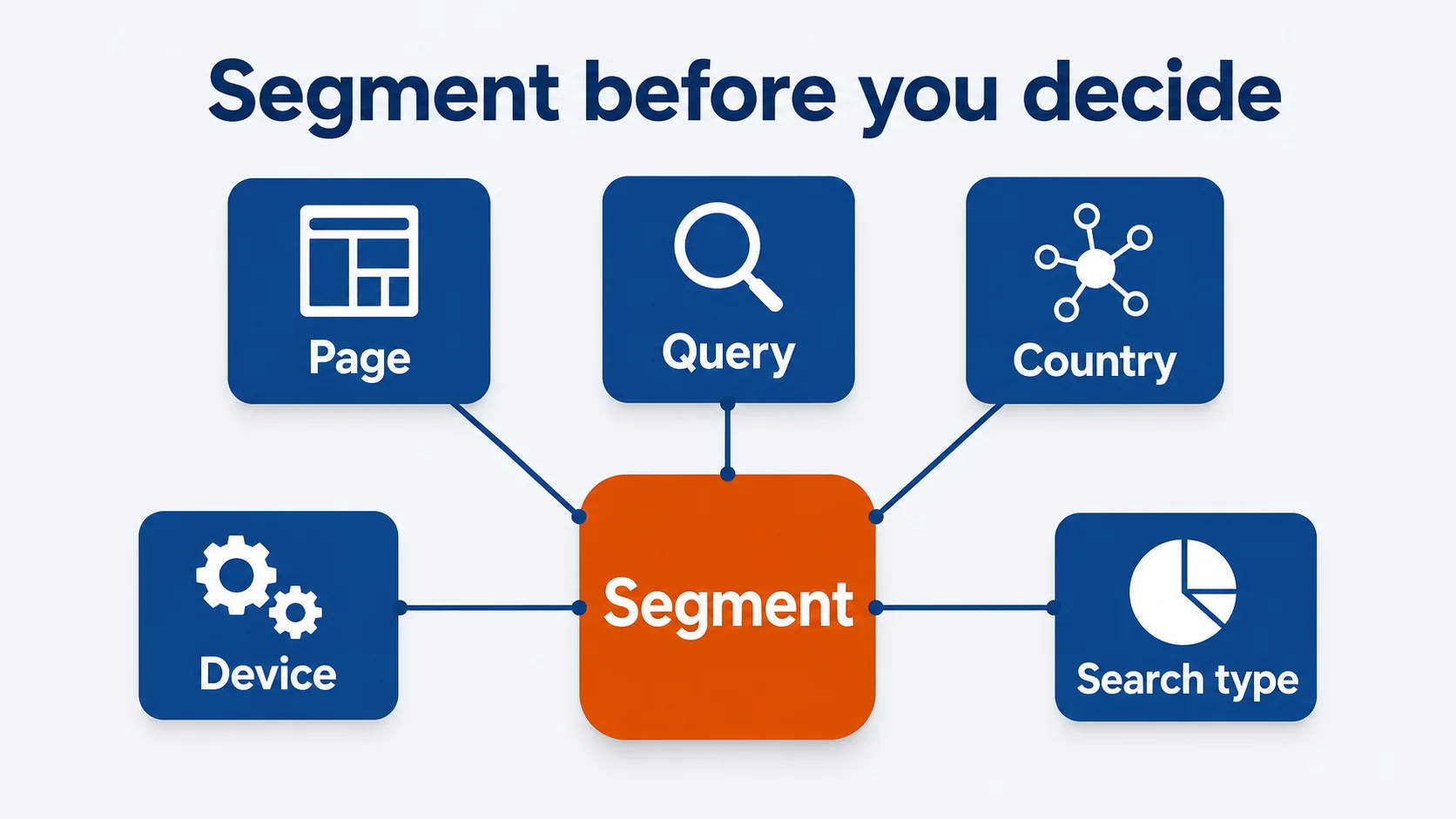
- Segment Search Console by page, query, country, device, and search type.
- Separate small ranking shifts from large, sustained drops.
- Check whether impressions fell, rankings fell, click-through rate fell, or all three moved together.
- Review affected pages manually before editing them.
Google’s traffic-drop debugging guidance is useful here because not every decline is a core update. A site can lose traffic because of a noindex mistake, crawl error, server problem, migration issue, manual action, spam issue, seasonality, reporting change, or demand shift.
This is where analytics and reporting matter. The same ranking decline can have different business impact depending on which pages changed and whether those pages drive leads, revenue, or only low-intent traffic. If you need a deeper measurement framework, our guide on how to measure SEO performance walks through the metrics that make this analysis cleaner.
Look at page groups, not only individual URLs. If one article drops but the rest of the cluster holds, the problem may be page-specific. If every article in a subfolder loses impressions while service pages hold steady, the pattern may point to content-type quality or freshness. If only one country changes, international SERP movement may be distorting a global report. If mobile drops while desktop holds, template or performance issues deserve attention.
That segmentation keeps the response proportional. A small rank change on a noncommercial query may only need monitoring. A sustained drop on a revenue page with falling impressions, falling clicks, and new competitors above it deserves a serious refresh plan.
What To Fix After a Google Core Update
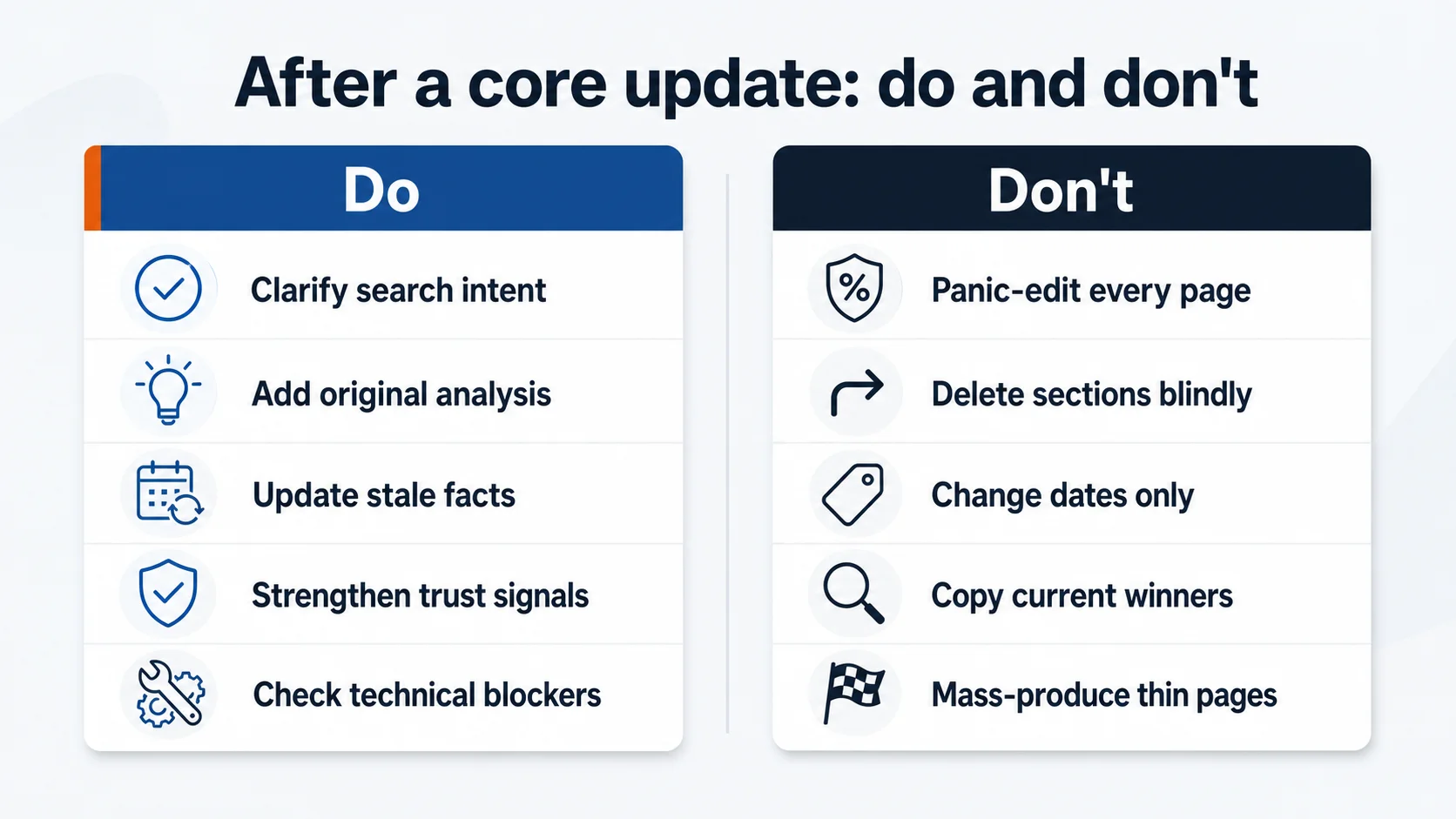
Do not panic-edit every page. Broad core updates can take time to understand, and quick fixes often create more noise than progress.
Start with the pages where ranking movement, impression loss, and business value overlap. A page that lost one low-volume query may not need immediate work. A service page, product category, or article that lost several high-value queries deserves a closer review.
Then improve the page in ways users can actually feel:
- Clarify the search intent the page serves.
- Add original analysis, examples, screenshots, workflows, or first-hand expertise.
- Update stale facts, dates, tools, and recommendations.
- Remove or consolidate thin sections that repeat what every other result already says.
- Strengthen author, source, and trust signals where they matter.
- Improve internal links so important pages are easier to reach.
- Check technical blockers such as canonicals, indexation, crawl paths, structured data eligibility, and Core Web Vitals.
For many sites, an SEO audit is the right first step because it separates content-quality work from technical cleanup. If the loss came from a blocked template, a weak redirect map, or a canonical problem, rewriting copy will not fix the root cause. If the loss came from thin or outdated content, a technical checklist will not be enough.
Google’s helpful content guidance is the right lens for the editorial side. A refreshed page should provide original information, clear expertise, substantial value compared with other results, and a reason for a reader to trust it. In practice, that usually means fewer generic summaries and more useful decisions: what changed, what matters, what to check first, and what not to overreact to.
A useful content review should be specific. Check whether the page answers the query directly in the first few paragraphs. Check whether headings match the real questions searchers ask. Check whether examples, screenshots, data, or experience make the page different from the next ten results. Check whether the page has been patched year after year until it no longer has a clear point.
Then decide whether to refresh, consolidate, or leave it alone. Some pages need a new section. Some need stale advice removed. Some need two overlapping URLs merged into one stronger resource. Some should not be touched because the data does not show meaningful loss. Good recovery work is selective.

What Not To Do After a Google Core Update
The fastest way to make a core-update problem worse is to react before you understand the pattern.
Do not delete sections just because rankings moved. Do not rewrite a page that only had a small fluctuation and still satisfies the search intent. Do not update dates without making a material improvement. Do not mass-produce near-identical pages to look fresh. And do not assume every decline came from the update window.
Be especially careful with “SEO fix” lists that promise recovery from one tactic. Core updates do not usually have one button to push. A title rewrite may help if the old title was weak. A content refresh may help if the page was stale. A technical fix may help if Google could not crawl or interpret the page. But the right fix depends on the actual evidence.
Black-hat tactics still create risk, but the bigger issue for many legitimate sites is lower-value content. A page can be technically allowed and still be less useful than what now ranks above it.
Avoid another common mistake: copying the current winners without understanding why they won. A competitor may rank because it has better links, stronger brand demand, fresher examples, more complete coverage, or simply a closer match to the query. If you copy its headings and add a few new paragraphs, you may create a larger version of the same weak page. Use the SERP to understand expectations, then build a page with a clearer point of view.
How To Prepare for the Next Google Core Update
The best time to prepare for a core update is before rankings move. That preparation is less about guessing Google’s next change and more about building pages that deserve to hold up.
Keep a baseline for priority URLs. Track their top queries, impressions, clicks, conversions, and business value before volatility hits. When an update rolls out, you will know which pages changed and which held steady.
Make your important pages easier to trust. That can mean clearer authorship, stronger citations, original examples, better case-study support, fresher screenshots, cleaner schema eligibility, and more useful internal links. It can also mean removing weak content that exists only because a keyword tool once listed a phrase.
Technical health also matters. Search engines need to crawl, render, index, and understand the pages you care about. Core Web Vitals, mobile rendering, canonicals, redirects, XML sitemaps, internal links, structured data, and index coverage all shape whether good content can perform.
OuterBox builds Google SEO services around that mix: search data, technical access, content quality, internal linking, page experience, and measurement. A core update is easier to weather when the whole program is documented and the team knows which pages matter most.
That documentation does not have to be complicated. Keep a short record of what changed on important pages, when the change shipped, what queries the page is supposed to win, and what metric will tell you whether the update helped. When the next core update rolls out, that record gives your team a cleaner baseline than memory, screenshots, or a panicked Slack thread.
The same discipline applies to new content. Before publishing a page, ask what unique value it adds to the site. If the answer is only “we found a keyword,” the page may not be worth building. If the answer is “this page helps a buyer diagnose a problem, compare options, or make a better decision,” it has a better chance of surviving the next reassessment.
Google Core Update FAQ
How often does Google run core updates?
Google usually runs several broad core updates per year, but the exact number and timing vary. Smaller ranking changes happen more often. Use Google’s Search Status Dashboard and Search Central announcements to confirm broad core updates instead of relying only on social posts or volatility tools.
Was the March 2026 Google core update a penalty?
No. The March 2026 core update was a broad ranking update, not a manual penalty. A site can lose rankings during a core update without violating a policy. That said, spam issues, manual actions, technical problems, and content-quality weaknesses can also cause traffic drops, so the diagnosis still matters.
How long does Google core update recovery take?
Google says improvements can take days to months to show in Search, and there is no guaranteed recovery timeline. Some pages improve after a meaningful refresh and recrawl. Others need broader site-quality, technical, or authority work before rankings change.
Should I change content immediately after a core update?
Wait until the rollout completes and at least one full week of post-update data is available. Then compare the right periods and review affected pages. If a page still meets intent and only moved slightly, you may not need a major rewrite. If it lost important queries, improve it with evidence.
Can technical SEO problems look like a core update hit?
Yes. Noindex tags, crawl errors, server failures, canonical mistakes, migration issues, redirect problems, JavaScript rendering issues, and analytics changes can all look like a ranking update at first. Rule out technical causes before you assume the core update is the whole story.