By: Jeff Hirz
SEO Performance is the real driver behind the success or failure of your SEO campaign. Whether you handle your search engine marketing in-house or hire an SEO agency to develop and manage your campaign, it is extremely important to be able to measure the performance and results of your SEO efforts. Accurate measurement shows which tactics are working, which ones are wasting time, and where you should focus next to improve traffic, revenue, or lead generation.
Good SEO measurement is not just a dashboard full of rankings. It starts with a business goal, then uses the right data sources to judge whether search is helping you reach that goal.
How To Measure SEO Success
Not every company will find it simple to define those goals, especially if we are talking about a startup company or an existing business attempting to adapt to an increasingly digital world with no idea where to begin. If that is the case, I would strongly recommend scheduling a consultation with a professional SEO agency. A reputable SEO company can perform an audit of your website, identify preexisting weaknesses, analyze your competition, and provide a high-level overview of what you would be up against. They should also be able to use data and experience to help you create realistic goals.
That goal may be revenue. It may be qualified leads. It may be lower dependence on paid media, stronger visibility for a new product category, more non-branded traffic, or recovery after a migration. The point is not to pick every metric at once. The point is to decide what a successful SEO campaign should change for the business.
It may seem somewhat counterintuitive to determine how successful your SEO campaign has been in hindsight if you never established any goals before the campaign started. Remember, beauty is in the eye of the beholder. If your company set a goal to improve organic traffic by 5% year over year, allocated the appropriate resources toward attaining that goal, and then achieved an organic traffic increase of 10%, you could view this campaign as extremely successful.
However, if the goal had been to double organic traffic, the same campaign would be perceived as a complete failure. For this reason, your SEO goals should be well established before the campaign truly begins. Without those goals, you have no baseline to grow from. Determining how much of your marketing budget should be allocated to online marketing is also nearly impossible without a target in place, meaning you have a good chance of either underspending or overspending.
How SEO Performance Success Is Measured After Goals Are Set
There are a number of things to look at when gauging the success of your SEO campaign. To make informed decisions, you need data about your website, your search visibility, and your conversions. Google Analytics 4 and Google Search Console are the two free first-party tools most teams should have connected first. GA4 helps you understand on-site behavior and conversions. Search Console helps you understand how Google is showing, crawling, indexing, and sending traffic to your site.
While analyzing every source of traffic has a role in shaping your campaigns, this article focuses mainly on organic statistics. In the digital marketing world, organic search results are the results that a search engine has listed due to relevance to a user’s query, not due to inorganic reasons such as paid placement. The word organic has transformed into a digital marketing industry adjective, indicating free search traffic from search engines, mainly Google, Yahoo, and Bing.
The best SEO measurement setup usually combines GA4, Search Console, rank tracking, backlink analysis, call tracking, and CRM or ecommerce data. If those systems are disconnected, you will still have numbers, but you may not have a useful picture of performance.

Analytical Data for SEO
Analytical data tells you what people do once organic search brings them to your site. These metrics do not replace rankings or backlinks, but they show whether SEO is helping real users take valuable actions. For most websites, the strongest view comes from GA4, Search Console, and conversion or revenue data reviewed together.
1. Organic Search Traffic
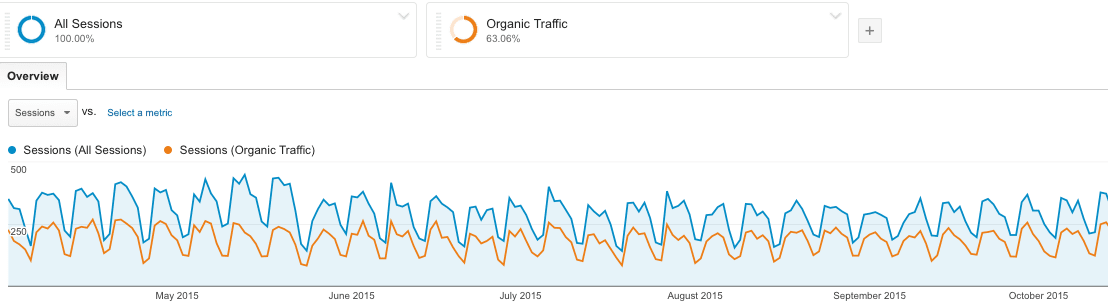
Of course, one of the most important metrics of your website is how many users visit your site from organic search. Track your organic search traffic monthly and make sure that, overall, it is increasing. You may have drops once in a while due to seasonality, promotions, tracking changes, or broader market conditions, but in general you want to see an upward trend in qualified organic visits.
In GA4, the Traffic acquisition report helps you review sessions by channel and source. Use it to isolate organic search traffic, then compare that traffic against total site traffic and other channels. Improvements in keyword positions should increase organic traffic because your results are listed more prominently where searchers are most likely to click. Search Console clicks give you a second view of that same question from Google’s side: how many users clicked your pages from Search.
Do not stop at the line chart. Segment organic traffic by landing page, device, geography, branded versus non-branded queries, and content type. If traffic is growing only because one blog post spiked for a low-intent query, that is different from category pages, service pages, or product pages gaining qualified visibility.
2. Organic Revenue

If you are dealing with ecommerce SEO and have properly implemented ecommerce tracking, you will have access to organic revenue data, meaning revenue your site earned from organic visits. You want revenue to increase month over month and year over year, but do not be discouraged by the occasional dip from seasonality or a promotional calendar. When you notice a dip that you lack an explanation for, it is time to dig deeper into your data. More about eCommerce SEO services.
In GA4, ecommerce revenue depends on clean event and purchase tracking. If purchases, refunds, product data, or checkout events are not implemented correctly, the organic revenue number will not tell the truth. For lead-generation companies, use lead value, qualified opportunities, or closed-won revenue from the CRM as the revenue layer. SEO performance marketing works best when it connects traffic to business outcomes rather than stopping at visits.
3. Engagement Rate and Bounce Rate

In Universal Analytics, bounce rate was one of the first engagement metrics most marketers checked. In GA4, engagement rate is usually the better starting point. Google defines an engaged session as one that lasts 10 seconds or longer, has one or more key events, or has two or more page or screen views. Engagement rate is the percentage of sessions that meet that standard.
That does not mean bounce rate is useless. A high bounce rate is not necessarily a bad thing, as it could simply mean that users immediately found the information they were looking for on the page they landed on and left. More often, however, a high bounce rate can indicate that visitors are not seeing what they had hoped to see after clicking your result. That could mean you are targeting the wrong keywords, that your site does not look legitimate, that the page is too slow, or that some other factor is preventing the visitor from engaging.
Looking at your entire website’s engagement rate can give you a high-level understanding of usability, but to make the metric more useful, analyze engagement from a page, category, traffic-source, and visitor-type basis. A blog post, product category page, and B2B service page should not all be judged with the same expectation.
4. eCommerce Conversion Rate
Your ecommerce conversion rate is the percentage of visits to your website that resulted in an ecommerce transaction. In GA4, you can review ecommerce purchases by traffic source, landing page, product, campaign, and other dimensions, assuming your tracking is set up correctly. That helps you understand whether organic traffic is actually converting to a sale.
A good ecommerce conversion rate is hard to define. In some industries, converting 1% of visitors into a sale or lead could be terrific. Make sure your organic ecommerce conversion rate is at least staying stable or slightly improving, and analyze your checkout funnels for drop-offs to determine what might be preventing users from making a purchase. Sometimes it can be as simple as adding trust badges to your store to make users feel more confident that their transaction is secure.
Any changes that you make to your website with the intent of converting a larger percentage of visits are known as Conversion Rate Optimization. Conversion rate optimization is the process of making strategic changes to your website with a hypothesis that they will improve your conversion rate. Any ideas that you think will improve sales can be tested with CRO software or controlled experiments, giving you the data needed to make an informed decision. More about Conversion Rate Optimization.
5. Average Engagement Time

Another important metric you can view in GA4 is average engagement time. This is the amount of time your website or app was in focus for the user, and it replaces much of the old mental model around time spent on page.
Average engagement time is especially useful on organic landing pages because these are the pages your organic visitors see first. If users arrive at a landing page and quickly navigate somewhere else, you may want to make it easier for them to find what they are looking for. If they stay with the page, scroll, click, and then convert later, short-term page-level judgment may miss the value. The goal is not to force users to spend more time for its own sake. The goal is to make the page useful enough that the right users can continue toward the action they came to take.
6. Key Events and Conversions
Google Analytics used to center this conversation on goals. GA4 is built around events, and the most important events can be marked as key events or used as conversions depending on the reporting context. Practically any meaningful action a user could take while on your website can be tracked: clicking an element, submitting a contact form, calling a phone number, downloading a file, starting checkout, or making a purchase. You can also implement more abstract events such as a user spending a predetermined amount of time on a given page. Some of the more sophisticated events may require a bit of JavaScript help from your front-end developers.
Think about the overall purpose of your website to determine what actions you would like visitors to take, then track their completion monthly. Compare organic key events to total key events to understand where your conversions are coming from each month. Ideally, organic conversions will increase as your site’s visibility in search improves, resulting in increased leads and revenue.
For lead-generation sites, make sure form submissions, calls, appointment requests, live-chat leads, and offline CRM outcomes are not treated as interchangeable. A low-quality lead and a sales-qualified lead should not receive the same weight in your SEO report.
7. Percent of Total Traffic That Comes from Organic
The larger the percentage of your total traffic that comes from organic, the more you are relying on organic search to drive traffic to your site. Typically, we aim to have a high percentage of traffic come from organic, as this traffic is free once you have earned the rankings. Pay attention to how much of your site traffic comes from organic search and whether that percentage is rising or shrinking.
If the organic percentage starts to drop, you may need to rethink your SEO strategy. Of course, other sources of traffic are very important too, and a shrinking organic traffic percentage may simply mean you have been paying more attention to social media, email, paid search, or paid social. The context matters. A healthy paid-media push can lower organic share while the actual organic traffic number still grows. Always review share of traffic alongside total traffic and conversion value.
8. Pages Per Session
The more pages a visitor views after arriving at your site, the more engaging your site may be. At its core, Google aims to serve people relevant, useful websites that offer value that cannot be found elsewhere, or at least cannot be found easily. Looking at pages per session from an organic standpoint may tell you that you are targeting the right users or that users do not have much interest after arrival.
On the other hand, your visitors may be interested in your content, but your site may not be user-friendly enough.
This is also a metric where site type matters. A long-form article may answer a question in one visit. A B2B service page may need to lead into case studies, pricing guidance, and a contact form. An ecommerce category page should often lead into product pages. Judge the number against the job the page is supposed to do.
9. New vs. Returning Users

The number of visitors that return to your website can help you understand how engaging your website is and whether users are identifying with your brand. Even if you convert 100% of your visitors, if none of them return to convert again in the future, you are losing out on a source of revenue. Ideally, your visitors will not just make a sale. They will share their purchase on social media, post links in online forums like Reddit, and return to make another purchase.
GA4 provides this data through user and retention reporting. Pay attention to the ratio of new visitors to returning visitors and how it changes over time. If new users are rising but returning users are flat, you may be reaching more people without building loyalty. If returning users rise but new organic visibility stalls, you may have a brand-strength story but a discovery problem.
10. Indexing and Crawl Health
Search engines rely on automated programs that crawl your website in order to add it to their index. No matter how useful your website is, if Google and the other search engines cannot discover, crawl, render, and index your pages, your rankings will suffer.
The old crawl-errors mental model is now better handled through the Page Indexing report and URL Inspection in Google Search Console. The Page Indexing report shows which pages Google can find and index on your site and identifies indexing problems encountered. If you have thousands of indexing issues showing in Search Console, odds are there are some other glaring SEO problems. Review the reasons pages are not indexed, check whether important canonical URLs are affected, and use the URL Inspection tool when you need to diagnose a specific page.
This is one of the places where technical SEO and measurement overlap. A ranking decline may look like a content problem until you discover that important templates are noindexed, canonicalized incorrectly, blocked by robots.txt, or failing to render.
11. Traffic By Device Type
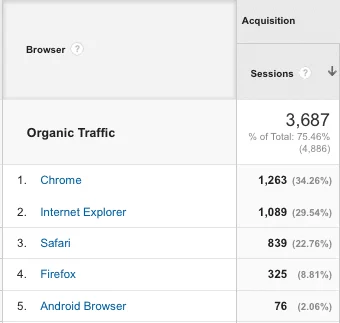
With more users accessing the web without conventional desktop computers, it is important to pay attention to which devices users are using to access your website. You need to know what devices your visitors use so you can deliver the most useful view of your site to each visitor.
Google has retired the old Mobile-Friendly Test and Mobile Usability report, so current checks usually happen through PageSpeed Insights, Lighthouse, Chrome UX Report data, and Core Web Vitals reporting. Review device-level traffic and conversion data in GA4, then pair it with performance and usability checks. If mobile traffic is high but mobile conversion rate is weak, the problem may be layout, speed, navigation, forms, checkout, or content fit.
You can dig deeper into this data to see if most of your users prefer one type of device versus another. For example, if the majority of your mobile users are on the Android OS, you can prioritize optimizing your site for Android devices before worrying about iOS devices.
12. Phone Tracking
You are not getting a clear picture of your SEO campaign results unless you are tracking phone calls from your site. This is especially true for lead generation sites and is more important for some industries than others. Depending on the industry, up to 100% of your leads can arrive via phone calls. Without call tracking implemented, you will have very little insight into how those customers found you.
Call tracking provides customer data and information that enables you to make more informed strategic decisions and focus your efforts on the traffic sources that work for you. Some call tracking services are more detailed than others, but most will allow you to see the traffic source that drove the call, the duration of the call, the landing page, the campaign source, and other relevant information.
Some companies offer products and services that lend themselves to a discussion over a phone call before ordering. This is especially true in many B2B industries. Call tracking is one of the most important elements of a digital marketing campaign and should absolutely not be overlooked.
13. Search Console First-Party Metrics
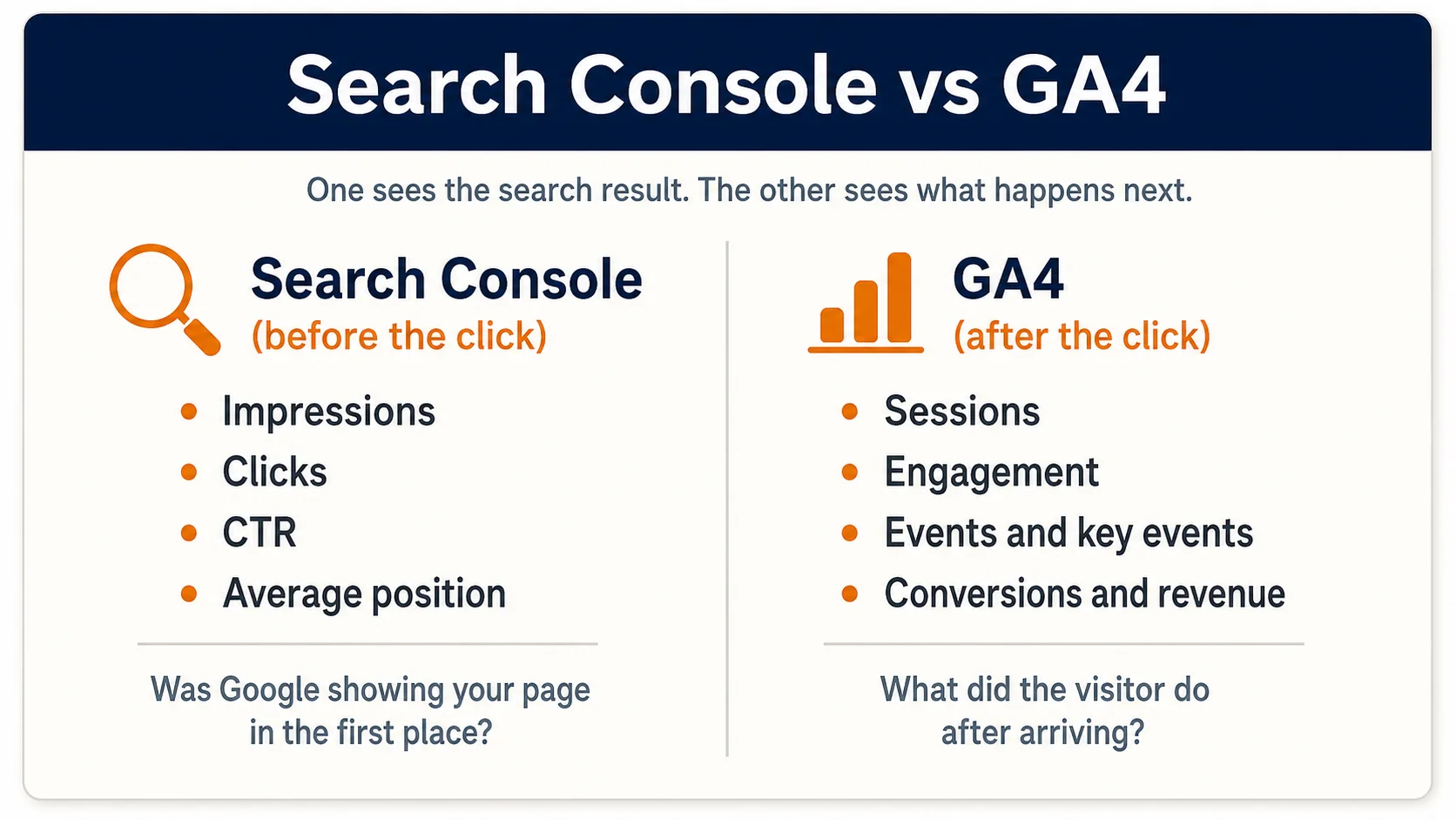
Google Search Console is where you see how your site performs inside Google Search before the visitor reaches your website. The core Performance report metrics are impressions, clicks, CTR, and average position. Impressions tell you how often a result from your site appeared. Clicks tell you how often searchers clicked through. CTR shows the relationship between those two. Average position estimates where your result appeared across the queries and pages being reported.
This is one of the cleanest ways to track SEO performance because it uses first-party Google Search data. GA4 can show what happened after the visit. Search Console can show whether Google displayed the page in the first place. If impressions are rising but clicks are not, the page may need stronger titles, better descriptions, stronger alignment to intent, or a higher ranking position. If clicks are rising but conversions are not, the issue may be landing-page fit, offer, UX, or tracking quality.
For better reporting, connect Search Console with GA4 and Looker Studio or a marketing dashboard such as LOOP Analytics. That makes it easier to review query, page, traffic, and conversion data in one place.
14. Core Web Vitals
Core Web Vitals are not a replacement for content, links, and technical fundamentals, but they are measurable user-experience signals that belong in an SEO scorecard. The three main metrics are Largest Contentful Paint, Interaction to Next Paint, and Cumulative Layout Shift. Google’s good thresholds are LCP at 2.5 seconds or faster, INP at 200 milliseconds or faster, and CLS at 0.1 or lower.
These metrics matter because organic users do not experience your rankings in a vacuum. They click a result, wait for the page, try to interact, and decide whether the page feels stable enough to use. Slow templates, jumpy layouts, heavy JavaScript, oversized images, and third-party scripts can all reduce the value of otherwise strong organic visibility.
Review Core Web Vitals in Search Console for field data and use PageSpeed Insights or Lighthouse for diagnostics. If a page drives valuable organic traffic but fails CWV thresholds, treat that as a performance and SEO measurement issue. For larger fixes, this usually belongs in a technical SEO workflow with development support.

Remember, data is objective but your interpretations are subjective. Be sure to dig deep enough to find causation in your data, not just correlation.
Keywords Help You Track SEO Performance

Apart from analytical website data, there are other things we can track that do not necessarily occur on your site but are still important indicators of a successful SEO campaign. Keyword rankings are still useful, especially when they are tied to traffic, search intent, and business value. Most SEO companies use third-party software to track keywords each month. These applications track your keywords historically so you can see which are improving and which are losing traction.
Here are some things to keep in mind when analyzing your website’s keyword rankings:
15. Keyword Volume
Are you targeting keywords that are actually searched frequently? Ranking on the first page for hundreds of terms that nobody searches for is worthless. Imagine your business sells dogs, cats, monkeys, unicorns, and lizards. All other things equal, it would be wise to focus your efforts on dogs, since it gets the most search volume. However, we know that all things are not equal and profit margins on unicorns are just outrageous these days.
Volume is not the whole story. A lower-volume keyword with strong commercial intent may be more valuable than a high-volume keyword that attracts the wrong audience. Use volume to size the opportunity, then use intent and conversion data to decide whether the keyword deserves attention.
16. Keyword Relevance & Search Intent
Are the keywords that you are targeting relevant to your audience? Is there a clear search intent, and are you delivering what the searcher is most likely searching for? For example, if your website sells unicorns, ranking for free unicorns is not nearly as beneficial as ranking for unicorns for sale. Still, a fraction of those looking for free unicorns may be persuaded into buying some, so do not completely write those keywords off.
Intent is where many SEO reports go wrong. A ranking gain is not automatically good if the keyword brings students, job seekers, researchers, or international traffic that will never buy from you. Track keyword groups by intent and landing-page type, not only by raw position.
17. Keyword Quantity
Of course, we want relevant keywords that are searched frequently, but we also want a lot of them. Each month, you should track the number of keywords ranking number one overall, how many are on the first page of the results, and how many are on the second and third pages. Look for increases in these numbers each month and avoid losing rankings on keywords that have already proven successful sources of qualified traffic.
Each relevant keyword that your site ranks for can result in an increase in organic traffic. The more useful question is whether your keyword footprint is expanding in the right clusters. If you sell B2B software, more rankings around enterprise integrations may matter more than more rankings around broad definitions.
Backlink Profile

Apart from dissecting your website’s analytical data and tracking your keyword rankings, what else can we do to measure the effectiveness of our SEO campaigns? One of the most important aspects of performing SEO is earning new links to your website and content, so it is important to analyze every aspect of your backlink profile to check if you are earning relevant links from quality domains.
Just like every other aspect of SEO, there is a tool for that. There are plenty of tools available to check your backlink profile. These tools crawl the web and note each hyperlink they encounter. Enter your domain and you will be given data relating to the links on the web that point to your site.
Google uses your backlink profile as a ranking factor, but this is not the only reason to be concerned with links. If you are consistently earning new links to your site, it means you are creating engaging content that users find valuable, which is an indication in and of itself of strong SEO. Here is what to look for:
18. Domain Quantity
How many separate domains link back to your site is an indication of how trustworthy you are. Generally speaking, the more quality domains that link to your site, the better. Look at the trend over time, not only the total count. A healthy site should earn new referring domains while avoiding obvious spam patterns.
19. Domain Quality
Links from CNN.com are likely more valuable than links from TommysAwesomeBlog.com, since CNN.com has a very strong backlink profile of its own. The quality of a domain is assessed by the search engine using a number of metrics, including backlink profile, topical authority, history, and many other factors.
Do not judge a backlink program only by volume. One relevant, trusted industry publication can be more meaningful than dozens of weak directory links.
20. Domain Relevancy
It is not just the amount of domains and their quality that matters, but relevancy as well. Google’s search algorithm is capable of making many different types of associations. If you sell spaceships, a link from NASA.gov is much more beneficial than one from NSA.gov.
Relevance is why link reports should be reviewed by someone who understands the business. A domain can look strong in a tool but still be a poor fit for the audience, geography, or topic you care about.
21. Page Quality
Similar to domain quality, but on a page basis. If your links are coming from low-quality pages on strong domains, they will not have as big an impact as if they were coming from high-quality pages on the same domain. Look at the page’s topic, crawlability, traffic potential, placement, and whether the link appears editorially natural.
This is also where internal links matter. A strong domain can bury a link on a page that has no visibility or no relevance. A smaller but highly relevant page can send clearer authority and referral signals.
22. Anchor Text
Anchor text distribution is still one of the easiest ways to spot whether a backlink profile looks natural. The short and simple explanation is that your website should have as natural of a backlink profile as possible, including the anchor text of those links. If you look at any big brand website, you will see a natural distribution of the anchor text used in inbound links. For example, let’s look at Lowes.com.

The vast majority of inbound links to Lowes.com have branded anchor text simply containing the company’s name. Rest assured, the grand majority of Lowe’s backlinks were naturally occurring links that were built by customers and other internet users. Looking at their anchor text profile, we see hardly any keyword-optimized anchor text. Why is this the case?
If you look at any big brand website, you will see the same pattern. Google recognizes these patterns among legitimate and trusted websites. Websites that have unnatural anchor text distribution containing more keyword-optimized anchor text than branded or generic anchor text stick out like a sore thumb. It is one of the easiest ways for Google to put your website on a list you do not want it to be on.

In the counter-example from the original article, the affiliate website Custom Printing Deals had a very unnatural anchor text distribution. Over 85% of their referring pages had keywords in their anchor text that they were targeting. It was quite obvious that this was attempted rank manipulation and that unnatural links were being built. Please, do not ever do anything like this.
If you are going to be building links as a part of your SEO campaign, try to keep 95% or more of the links branded with the name of the company, raw URL variants, or generic anchors such as this website or source. The other 5% of links that you are building can contain keywords that you are targeting. Remember to be natural about it and use variants such as brand name plus keyword. So if we imagine we own a company called Poppashawts and a targeted keyword was orange widgets, we would want the anchor text to read something like Poppashawts Orange Widgets.
What Is SEO Performance in AI Search Visibility?
AI search visibility is becoming part of SEO measurement, but it should be treated as directional, not precise. Google says sites appearing in AI features such as AI Overviews and AI Mode are included in overall Search Console traffic and reported in the Performance report under the Web search type. That confirms AI-feature visibility belongs in the reporting conversation, but it does not give marketers a clean citation-by-citation dashboard.
For now, track AI visibility with a few practical signals: whether your brand or content is cited in AI Overviews for priority queries, whether third-party AI search tools mention your brand, whether referral traffic from AI systems appears in analytics, and whether branded search demand changes after AI visibility improves. Tools in this category are still maturing, so avoid treating any single AI visibility number like revenue or Search Console clicks.
The useful question is simple: when searchers ask the questions your business should be known for, are you present in the answers, and is that presence improving over time?
Analyze, Strategize, and Revise When Tracking Your SEO Performance
Every SEO campaign is going to include some strategies that are more effective than others. The key to measuring the effectiveness of your SEO campaign is not only determining whether your campaign has been successful overall, but also identifying which aspects have proven beneficial. This will enable you to channel more resources to the strategies that are working for you and replace those that have not with new ideas.
A practical reporting rhythm helps. Many teams check rankings and technical alerts weekly, review GA4 and Search Console trends monthly, and audit backlinks, Core Web Vitals, content decay, and revenue attribution quarterly. The cadence matters less than the habit of turning data into decisions.
If your team has the data but no clear action plan, SEO services should help connect the report to the next move: technical fixes, content updates, internal links, conversion improvements, or authority building.
Frequently Asked Questions About SEO Measurement
What is SEO performance?
SEO performance is the measurable impact of your organic search work. It includes rankings, impressions, clicks, traffic, revenue, leads, engagement, indexing health, backlink quality, and other signals that show whether search visibility is helping the business. The best definition depends on your goal. A publisher may care most about organic sessions. An ecommerce company may care most about organic revenue. A lead-generation company may care most about qualified opportunities.
How do you measure SEO performance?
Start by defining the goal, then pick metrics that prove progress toward that goal. Most teams should track organic traffic and conversions in GA4, impressions and clicks in Search Console, keyword rankings in a rank tracker, crawl and indexing health in Search Console or a crawler, Core Web Vitals in PageSpeed Insights or Search Console, and backlink quality in a link-analysis tool. Then review the data by page, query, device, channel, and business outcome.
What are the most important KPIs for SEO?
The most important KPIs are usually organic traffic, organic conversions or revenue, Search Console impressions and clicks, non-branded keyword rankings, indexed pages, Core Web Vitals, and quality referring domains. The right mix depends on the site. A local lead-generation business should put more weight on calls and form submissions. An ecommerce site should put more weight on revenue, conversion rate, and category-page visibility.
How long does SEO take to show measurable results?
Some SEO changes can show early movement in a few weeks, while larger changes can take several months to affect rankings and traffic. Competitive topics often need 3 to 6 months before a trend becomes meaningful and 6 to 12 months before compounding gains are obvious. Google also notes that some changes take hours while others can take several months, so do not judge an SEO program from one short reporting window.
How do you measure SEO ROI?
Measure SEO ROI by comparing the value created by organic search with the cost of the SEO work. For ecommerce, that usually means organic revenue minus campaign cost. For lead generation, it means assigning value to qualified leads, opportunities, or closed sales that originated from organic search. CRM data is important here because form fills and calls are not always equal in quality.
Which is better for measuring SEO: Google Analytics or Google Search Console?
Use both. Search Console shows how your site performs in Google Search before the click: impressions, clicks, CTR, average position, indexing, and page experience data. GA4 shows what users do after they arrive: sessions, engagement, events, purchases, and other conversions. Search Console answers whether Google is showing and sending traffic to your site. GA4 answers what that traffic does once it gets there.
How often should you report on SEO performance?
Weekly checks are useful for rankings, technical alerts, indexing problems, and major traffic changes. Monthly reporting is better for organic traffic, conversions, Search Console trends, content performance, and revenue. Quarterly reviews should look at bigger strategic questions: backlink quality, content decay, Core Web Vitals, competitor movement, and whether the SEO program is still aligned with business goals.
How do you measure SEO in AI search?
AI search measurement is still developing. For now, track whether your brand or pages appear in AI Overviews for important queries, whether AI tools cite or mention your content, whether AI systems show up as referral traffic, and whether branded search demand changes after visibility improves. Treat these as directional signals. They should supplement Search Console, GA4, rankings, conversions, and revenue rather than replace them.