
Industrial Digital Marketing Services
Industrial buyers do not move from a broad search to a simple form fill. They compare product families, specifications, applications, quote paths, paid listings, technical content, and supplier credibility before sales ever sees the opportunity.
OuterBox connects that full path around qualified RFQs, ecommerce demand, inside-sales context, and lead-quality reporting.





Industrial Marketing Has To Match How Technical Buyers Search
Industrial demand is specific before it is branded. A buyer may start with a product family, material, tolerance, certification, replacement part, brand, SKU, application, or capability before they ever search for a company name. That demand is easy to miss when the marketing plan is built around broad keywords and generic service pages.
The sales path is also different. A serious buyer may need enough information to decide whether your company can support a quote, a spec review, a replacement part, a distributor path, a repeat order, or a technical conversation. The first conversion may be a phone call, contact form, RFQ, quote cart, ecommerce order, sample request, distributor handoff, or rep-led purchase order. Each path needs context that helps sales understand fit.
Generic channel activity usually breaks when every team is judged in isolation. SEO can chase traffic while product and spec demand stays unsupported. Paid search can buy clicks that look efficient until sales rejects the requests. A redesign can make the site look cleaner without fixing product data, quote fields, catalog paths, or reporting. CRO can improve a form without asking what sales needs to qualify.
The parent industrial marketing page has a specific job. It should not replace deeper Industrial SEO, Industrial PPC, Industrial CRO, Industrial Web Design, Industrial Web Development, Manufacturing, Distributors, OEM, Contract Manufacturing, or Machine Shop pages. It should explain how the channels work together when the buyer journey runs from product and spec demand to website evaluation to a quote, call, ecommerce order, or sales-qualified conversation.
OuterBox builds industrial programs around that connected path. The goal is not more channel activity. The goal is better visibility for high-fit product and application demand, stronger conversion paths for RFQs and ecommerce, and a clearer read on which inquiries deserve follow-up.
How Industrial Buyers Evaluate A Marketing Partner
Industrial buyers move through a few consistent evaluation points before they trust an agency with technical demand. These tabs walk the questions engineers, procurement, and leadership actually ask.

Product & Spec Search Visibility
Can buyers find us by product, spec, material, part, application, or industry?
Industrial buyers often search with the detail sales teams hear on calls: product family, part type, material, size, application, certification, brand, SKU, or replacement need. Your SEO program needs pages that can answer those searches without forcing every buyer through a generic service page. Rapid Rivets showed the value of this approach when B-SMART content additions created new product-request opportunities from spec-driven pages. The parent program should connect those organic pages to paid demand, quote paths, and reporting so search visibility turns into useful sales conversations.
Paid Demand Controlled By Buyer Fit
Are campaigns reaching industrial buyers or paying for broad clicks?
Industrial paid media can spend quickly on searches that look relevant but never become qualified demand. Your campaigns need product-type structure, negatives for wrong-fit requests, landing pages that match the buying context, and reporting that separates a cheap lead from a useful one. In a precision-measurement paid media program, GPI Meters saw a campaign restructure and Shopping work produce a 425% paid conversion lift with a 48% lower cost per conversion. That is the standard the page should sell: paid demand controlled by fit, not volume.
A Website Built For Technical Evaluation
Does the site help technical buyers evaluate before an RFQ?
Your website has to carry more than brand credibility. Buyers need product data, capability detail, application context, quote-cart logic, and a path that tells sales what the buyer actually needs. A form that asks for only name, email, and message can force your team to requalify every inquiry from the beginning. Brazos Fasteners is the connected website example for this page: the site modernization, helpful content, and improved navigation show why product detail and buyer path clarity matter when industrial buyers need a specific part quickly.
Lead Reporting Sales Can Act On
Can sales see which inquiries are worth pursuing?
Industrial lead reporting has to move past raw form count. Your sales team needs to know which pages, campaigns, calls, forms, and product requests are creating opportunities with real fit. That may include quote-cart usage, product-line interest, source quality, call context, CRM feedback, and lead notes that explain why one inquiry is worth immediate follow-up while another is not. When reporting stays at traffic and conversions, leadership cannot decide which product family, paid segment, or content path deserves the next investment.
One Connected Industrial Program
Can one partner coordinate SEO, paid, web, CRO, content, and analytics?
Disconnected vendors create execution drag. SEO recommends new pages, paid sends traffic to old landing pages, web changes product templates without search context, and analytics reports clicks without sales feedback. An industrial program needs one plan for demand capture, product and capability content, paid media, quote paths, conversion improvement, and reporting. Fanuc World is the qualitative connected-program example in the packet: website, ecommerce, SEO, paid search, and remarketing worked together around a large industrial parts catalog and urgent parts demand.
Build a Marketing Strategy That Reaches Industrial Buyers
Reaching industrial buyers starts with understanding how they research suppliers, compare options, and decide who to contact for a quote. This overview breaks down how to build an industrial marketing strategy that connects search, paid media, content, and clear quote paths to the way technical buyers actually evaluate vendors, so the right decision-makers find you when they are ready to specify a part or choose a partner.
A practical look at targeting industrial buyers and building a marketing strategy that fits how they buy.
What Better Industrial Marketing Should Produce
Better industrial marketing should make the buyer path easier to see from both sides. The buyer should find the right product, capability, or application page faster. Sales should receive inquiries with enough context to understand fit. Leadership should see which demand sources are creating useful conversations instead of asking whether traffic alone is up.
That is the difference between channel activity and a connected growth program. Search and paid media bring qualified buyers to the right entry points. Web, content, and CRO help those buyers evaluate. Analytics and lead feedback show which pages, campaigns, product families, quote paths, calls, and content assets deserve more investment.
The outcomes to look for are practical: more qualified RFQs, stronger ecommerce demand, cleaner quote paths, lower waste in paid media, and reporting that helps the team choose the next move.
Product-Request Demand From Intent-Based Content
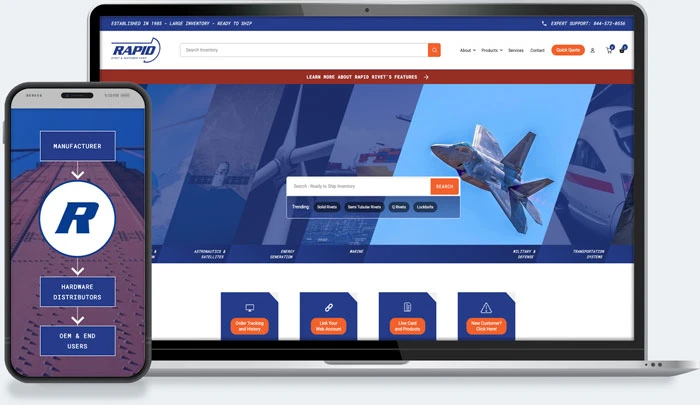
Rapid Rivets & Fasteners needed product content that matched how military, aerospace, and commercial buyers search for precision fasteners. OuterBox used B-SMART content additions to cover brands, specifications, materials, industries, and product types, then connected that search visibility to product-request opportunities.
Read the full Rapid Rivets case study to see how intent-based content connected industrial search demand to product-request opportunities.

An Industrial Marketing Partner That Connects Every Channel
Industrial companies need an agency that can coordinate search, paid media, web, CRO, content, and analytics without turning the program into a set of disconnected tasks. OuterBox brings those disciplines together around the same commercial question: which marketing work is creating qualified demand that sales can use?
That matters when product data changes, when paid media needs new landing pages, when SEO requires content for part-family searches, when web development affects crawl paths, and when leadership needs reporting that goes beyond traffic. The strategy has to survive the handoff between teams, not just look good in a kickoff deck.
An industrial internet marketing agency should understand that a paid media issue may be a landing-page issue, a quote-quality issue may be a form and content issue, and a traffic issue may come from product-family pages that are too thin or too hard to find. OuterBox helps connect those decisions before the next round of channel work starts.
20+ Years
Digital Marketing Agency
1000+
Successful Client Partnerships
2M+
Page #1 Google Rankings
300+
USA-Based, In-House Experts
Industrial Marketing Strategy Review
Request An Industrial Marketing Strategy Review
Bring OuterBox into the conversation before another campaign spends against the wrong demand path. We will review how buyers find you, where paid media is spending, how the website supports quote or ecommerce paths, and what reporting tells sales about lead quality.
Services
"*" indicates required fields
Where Generic Industrial Marketing Breaks Down
Industrial marketing usually fails in recognizable places. The problem is not always effort. It is often that the effort is aimed at the wrong signal or divided across teams that do not share the same sales context.

- Demand mapping: Product and spec demand gets mapped before content expands, so product families, applications, materials, and capability pages have clear search roles before the calendar grows.
- Paid efficiency: Paid media is judged by qualified conversion value, with structure around product type, intent, exclusions, landing-page fit, and lead-quality feedback.
- Quote paths: Quote paths ask for the details sales needs, including material, size, quantity, application, file upload, part number, and urgency fields when they fit the model.
- Connected execution: Web, content, SEO, and CRO decisions stay connected so site changes support crawlability, user experience, product data, search demand, and conversion quality together.
- Reporting: Reporting connects channels to lead quality, showing which pages, campaigns, calls, forms, and product areas are producing qualified demand.
What Generic Industrial Marketing Misses
- Demand mapping: The site gets more visits, but sales still receives vague inquiries that do not name a product, quantity, application, or fit requirement.
- Paid efficiency: Campaigns look busy while budget leaks into unsupported products, weak-fit searches, student traffic, job seekers, or broad terms that never become opportunities.
- Quote paths: Generic forms create undifferentiated leads, and sales has to ask basic qualifying questions before deciding whether the inquiry deserves follow-up.
- Connected execution: A redesign improves the look of the site but leaves search demand, catalog structure, quote paths, and reporting disconnected from buyer evaluation.
- Reporting: Dashboards stop at clicks, sessions, and form volume, leaving the team unable to tell whether marketing is creating pipeline or activity.
Industrial Marketing Resources

SEO | 16 min read
Whether you handle your search engine marketing in-house or hire an SEO agency to develop and manage your campaign, it is extremely important to be…

Digital Marketing | 5 min read
Website traffic is a vital driver of overall business growth, so it’s important to learn multiple methods to increase your website traffic. It improves your…

CRO | 5 min read
Ready to change your website into a conversion powerhouse? Mastering CRO (conversion rate optimization) best practices is your ticket to transforming casual visitors into loyal…

eCommerce | 5 min read
2020 dramatically changed B2B shopping behaviors across countless industries. Workers stayed home to slow the spread of the COVID-19 pandemic and turned to digital solutions…
How The Industrial Marketing Program Comes Together
The strongest industrial programs move in a practical sequence. The point is not to run every channel at once. The point is to find the demand path, fix the parts that block qualification, and report on the business signals that matter.

-
Map The Demand And Sales Motion. Your program starts with the way buyers search and the way sales qualifies. Product families, applications, materials, part numbers, quote paths, ecommerce behavior, distributor paths, and current lead quality all shape the plan.
-
Prioritize Product, Capability, And Content Gaps. Your pages should support the searches and buying questions that matter most. That may mean new product-family content, stronger capability pages, better internal links, updated service pages, or B-SMART-style content.
-
Align Paid Media With Buyer Fit. Your paid campaigns should support the same commercial map. Product-type structure, negative keywords, Shopping or lead-gen campaign decisions, landing-page fit, and cost per qualified conversion become part of the same program.
-
Improve The Website And Quote Path. Your site should help buyers evaluate and help sales prioritize. Catalog navigation, product data, application copy, quote-cart logic, form fields, call paths, and conversion testing serve the same handoff.
-
Close The Reporting Loop. Your leadership team should see which demand sources, pages, campaigns, and forms are creating useful conversations. Reporting should feed the next round of SEO, PPC, web, CRO, and content decisions.
More Industrial Marketing Services
Related Industrial Marketing Services






Build A Stronger Industrial Demand Path
Your next marketing investment should make the sales path clearer, not just add another channel report. Talk with OuterBox about the searches, paid campaigns, website paths, quote details, and lead-quality signals that should shape your industrial growth plan.
"*" indicates required fields
"*" indicates required fields
Industrial Digital Marketing FAQs
What is industrial online marketing?
Industrial online marketing is the connected use of SEO, paid media, content, web design, CRO, analytics, and related channels to help industrial buyers find, evaluate, and contact a supplier online. The work usually has to account for product families, specifications, quote paths, ecommerce behavior, long sales cycles, and lead quality.
How is this different from Industrial SEO or Industrial PPC?
Industrial SEO and Industrial PPC are child channel pages. This parent page covers the connected program across search, paid demand, website paths, conversion quality, content, and reporting. If the main need is organic visibility, start with Industrial SEO. If the main issue is paid demand quality, start with Industrial PPC. If several channels are disconnected, the parent industrial marketing review is the better fit.
How is industrial digital marketing different from manufacturing marketing?
The Industrial parent page covers the broader connected program for industrial companies. Manufacturing, OEM, contract manufacturing, machine shops, and distributors each have more specific buyer patterns and page boundaries. The parent should route to those pages when the buyer needs that narrower context, while still explaining how the full industrial program works.
Should an industrial company start with SEO or PPC?
The right starting point depends on demand, current visibility, paid waste, website readiness, and sales follow-up capacity. SEO is usually stronger for compounding product and spec visibility. PPC can capture demand faster when campaigns are structured around product fit and landing-page quality. The strongest programs often use both, with reporting that shows which channel creates qualified opportunities.
Can OuterBox support complex catalogs and RFQ paths?
Yes, when the engagement scope calls for it. Industrial programs can involve product-family structure, application content, ecommerce paths, quote carts, form fields, catalog navigation, ERP or CMS constraints, and reporting. The strategy should account for the buyer path and sales handoff instead of assuming every site needs the same build.
How should industrial lead quality be measured?
Lead quality should be measured by fit, not just count. Useful signals can include product or service area, quote details, call context, form fields, source, campaign, landing page, ecommerce behavior, sales notes, and whether the inquiry matches the company’s target customer. The exact reporting setup depends on the tools and sales process already in place.
What industrial proof can OuterBox show?
OuterBox has exact industrial proof from Fanuc World, Brazos Fasteners, and Rapid Rivets, plus related manufacturing and paid-media proof such as Weiss-Aug and GPI Meters. Each proof point should be labeled honestly. The parent page should not imply that one result covers every industrial sub-vertical or channel.
What makes an industrial internet marketing agency different from a general agency?
An industrial internet marketing agency should understand technical buyer behavior, product and spec searches, quote paths, catalog complexity, long sales cycles, and lead-quality reporting. A general agency may still run campaigns, but the work can miss the details that determine whether an inquiry is useful to sales.