
Generative Engine Optimization Services for AI Search Visibility
Generative engine optimization is now part of the search work your buyers expect to happen before they ever reach your site. They may see a Google AI Overview, ask ChatGPT for vendors, compare answers in Perplexity, or use Bing Copilot to narrow the problem before they click a result.
OuterBox GEO services help your brand become easier for answer engines to understand, cite, and trust. The work belongs inside the same SEO services foundation that already determines whether your pages can be crawled, interpreted, connected to authority, and turned into qualified action.
"*" indicates required fields
"*" indicates required fields





What Generative Engine Optimization Services Include
Generative engine optimization services prepare your website, content, schema, and entity signals for AI-assisted search experiences. The goal is not to trick a model. The goal is to make the right answer, proof, and attribution path easier to extract when AI systems summarize a topic.
That means GEO has to start with the same practical questions your SEO program already asks. Can search systems access the page? Does the page answer the buyer’s question directly?
The next layer is trust. Is the brand entity clear? Does the claim have proof near it?
The final layer is conversion. Does the next step make sense when a visitor arrives from an AI answer instead of a traditional blue link?
The old OuterBox GEO page made one point worth keeping: AI search optimization should not be a bolt-on project. OuterBox treats GEO as another layer of the search program, supported by technical SEO, content structure, prompt testing, entity work, internal links, analytics, and conversion paths.
What Do Our GEO Services Include?
A complete GEO program aligned to how LLMs retrieve, rank, and compose answers—built to integrate with your current SEO strategy.
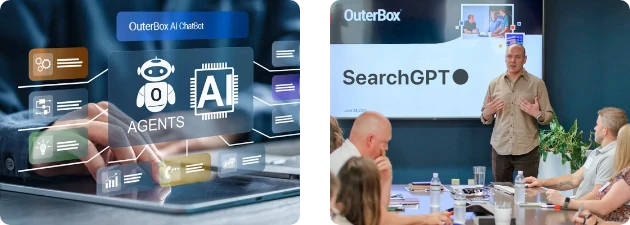
LLM Audit Framework That Shows What Answer Engines Can Extract
Your site can have strong organic rankings and still lose citation visibility when answer engines cannot isolate the useful passage. A generative engine optimization audit starts with the same infrastructure checks as technical SEO services, then adds LLM-specific scoring for extractability, entity clarity, and source attribution.
- Your priority pages are reviewed for schema coverage, answer-first headings, and passages that can stand alone in an AI response.
- Your brand entity is checked across organization schema, author profiles, about-page signals, and third-party mentions.
- Your most valuable claims are mapped to proof, date context, and source cues so models can verify what they repeat.
- Your baseline covers Google AI Overviews, ChatGPT, Perplexity, Gemini, and Bing Copilot prompts.
- Your fix list separates template problems from page-level content gaps before work gets assigned.
The audit gives your team a visible starting line for AI visibility, not another generic crawl export.
Prompt Testing for AI Visibility Across the Questions Buyers Ask
Buyer research now happens inside prompts about vendors, implementation steps, risks, and category recommendations. Prompt testing turns those questions into a tracked library, so lead attribution can connect AI visibility back to the channels, pages, and inquiries your team already reviews.
- Your prompt set reflects real buyer questions, service comparisons, use cases, and objections instead of vanity branded checks.
- Your inclusion, citation, and answer-position patterns are tracked by platform so one Google result does not distort the story.
- Your competitor mentions show where another brand is being cited for a question your pages should answer.
- Your prompt history shows whether visibility is improving, slipping, or changing because the answer format shifted.
- Your reporting separates prompt coverage from organic rankings so each channel keeps its own signal.
Prompt data gives your team evidence for which answer gaps deserve content, schema, authority, or measurement work next.
AI Search Optimization Built Into the Passages Engines Cite
AI systems need pages that make the useful answer easy to extract, verify, and attribute. Content marketing supports AI search optimization when service pages, articles, FAQs, and comparison sections use clear headings, concise answer blocks, and proof that travels with the claim.
- Your high-value pages use claim-evidence-source patterns so a model can separate the answer from surrounding sales copy.
- Your definitions, FAQs, and comparison points answer the question first, then add scope, proof, limitations, and next-step context.
- Your schema supports the page type, organization, author, service, breadcrumb, and FAQ context engines look for.
- Your internal links point users and crawlers toward the related service, article, or case-study page that explains the next layer.
- Your old thin passages become answer-ready modules instead of generic paragraphs that AI systems summarize around.
Content structure improves when every important passage gives the engine an answer, evidence, and a clean attribution path.
E-E-A-T Signals That Give LLMs Evidence to Trust
Trust signals matter more when an answer engine chooses which source to cite for a topic with business impact. OuterBox has worked in SEO since 2004, and AI SEO services build on that same discipline: make expertise visible to people, crawlers, and models at the same time.
Your authors, service pages, case studies, reviews, and organization details should tell one consistent story. Generative engine optimization makes those signals useful by connecting page claims to named experience, first-party proof, clear update context, and entity signals that match across schema, profiles, citations, and third-party mentions. If the evidence is only decorative, an LLM has little reason to carry it into an answer.
Trust signals become stronger when expertise, proof, and entity clarity support the same answer across every surface a model can read.
GEO and SEO Roadmaps That Move From Rankings to Citations
Search visibility now spans rankings, AI citations, answer inclusion, and brand mention share. SEO consulting helps generative AI SEO work belong inside the same roadmap, so GEO and SEO decisions compete by impact instead of living in separate task lists.
- Your technical fixes support crawl access, structured data, page speed, and passage retrieval in the same sprint.
- Your content briefs define the organic query target, the answer-engine use case, and the proof each section needs.
- Your link earning and brand mentions strengthen the entity signals that both search systems and LLMs evaluate.
- Your reports show rankings, citations, prompt coverage, and mention share in one planning view.
- Your priority calls weigh revenue pages, AI visibility gaps, implementation effort, and sales-team usefulness together.
Roadmap integration keeps optimization focused on the next decision that can improve both discoverability and trust.
Agency Enablement for Teams That Need to Read AI Search Performance
Agency enablement should leave your team with clearer judgment, not more dependence on a monthly explanation call. GEO digital marketing metrics can be unfamiliar at first, so the tab-level work has to make citation presence, mention share, prompt coverage, and escalation criteria readable for stakeholders who already track SEO performance.
Your team may also need tools that standard dashboards do not provide. AI development services can support custom prompt testing workflows, internal reporting views, or lightweight automation when the GEO process needs repeatable systems. The goal is not to replace strategic judgment; it is to make the right signal easier to see every week.
Enablement gives your marketers, analysts, and leadership team a shared way to evaluate AI search performance before the next roadmap decision.
What Changes When Buyers Search With AI
AI search compresses parts of the buying journey. A user can ask one question that blends education, comparison, risk, implementation, and vendor shortlisting. The answer may cite sources, summarize competing pages, or send the user into a follow-up conversation before any website visit happens.
Google’s AI features guidance says site owners should keep focusing on normal Search fundamentals, and it points to familiar controls such as snippets, indexing, and content quality. That guidance matters because GEO is not a separate technical universe. If the page is blocked, thin, unclear, stale, or disconnected from the rest of the site, AI systems have less useful material to work with.
Other answer engines add their own access and discovery patterns. OpenAI documents OAI-SearchBot for surfacing websites in ChatGPT search results, while Bing connects generative AI search features to its broader search and quality systems. Your GEO roadmap should account for those differences without pretending every platform uses the same signals.
GEO and SEO Belong in the Same Roadmap
GEO and SEO work best when they share priorities. Technical SEO services help search systems access and interpret the page. Content strategy shapes the answer, while internal links clarify relationships.
Authority and brand mentions support trust. Analytics shows whether the work creates demand your team can use.
Separating generative AI SEO from the rest of the program creates avoidable friction. A prompt test may reveal a missing comparison page. An AI Overview may cite a thin passage that needs better proof.
A ChatGPT answer may surface a competitor because your entity signals are weak. Each finding should roll into the same roadmap that already prioritizes crawl fixes, content updates, digital PR, CRO, and reporting.
That integrated plan also keeps GEO practical. Your team can decide whether the next move is a content update, schema cleanup, internal-link adjustment, authority push, FAQ rewrite, or measurement fix. The channel label matters less than the business question: which improvement makes your brand easier to find, trust, and contact?

GEO complements—not replaces—your SEO. By aligning structured content, schema, and trust signals, you can grow both organic rankings and AI answer visibility. Explore Our Technical SEO Services >
Meet the Team Behind Generative AI SEO
AI search is new in format, but the foundations behind it are familiar to teams that have been accountable for SEO through years of search changes. OuterBox has worked in digital marketing since 2004, and the team now includes 300+ USA-based, in-house experts across SEO, paid media, analytics, CRO, content, design, development, and strategy.
That structure matters for GEO. A useful recommendation may require schema cleanup, page-priority changes, rewritten answer passages, GA4 reporting work, and landing-page fixes for AI-referred visitors. One team can keep those pieces moving together.
OuterBox also brings the discipline behind 2M+ page-one Google rankings and 1000+ client partnerships. Those proof points are not guarantees for AI search. They show a search operating system that can diagnose, ship, measure, and keep improving as the interface changes.
Since 2004
Digital Marketing Agency
300+
USA-Based In-House Experts
2M+
Page #1 Google Rankings
1000+
Successful Client Partnerships
Content, Schema, and Entity Signals for Generative AI SEO
AI systems work better with pages that make the useful answer easy to find. Strong GEO content uses clear headings, concise answer passages, visible proof, updated context, and internal links that show which page owns which topic. Content marketing becomes more valuable when every important passage can stand on its own and still point back to the right authority.
Structured data still has to match the visible page. Organization, service, breadcrumb, author, FAQ, product, and review signals can clarify a page, but mismatched schema can create confusion. Google also documents snippet controls such as nosnippet, data-nosnippet, and max-snippet, so governance belongs in the same conversation as visibility.
Entity consistency is the connective tissue. Your brand name, service taxonomy, author signals, case studies, reviews, location details, sameAs profiles, and internal links should tell one story. When those signals disagree, an answer engine has to choose which version to trust.
GEO for Your Industry

- eCommerce & Retail
- B2B & Enterprise
- Automotive & Aftermarket
- Home & Industrial
- Health & Lifestyle
- SaaS & Technology
Get a GEO Readiness Plan
Ready to Improve AI Search Visibility?
We’ll get back to you within 24 hours, Monday–Friday. Prefer to talk now? Call 1-866-647-9218 (9–5 EST).
Services
"*" indicates required fields
Get a GEO Readiness Plan
Your current site already has signals that answer engines can use. It probably also has gaps: thin passages, unclear service ownership, missing proof, inconsistent schema, blocked snippets, weak internal links, or reporting that cannot explain AI-assisted demand. OuterBox can help you turn those gaps into a practical GEO roadmap. Bring us your priority pages, questions buyers ask, key competitors, reporting concerns, and current SEO constraints. Prefer to talk through it? Call (866) 647-9218.
"*" indicates required fields
"*" indicates required fields
Other SEO Services from OuterBox
Related Services That Support GEO

AI SEO Services
AI SEO services connect AEO, GEO, AI Overviews, ChatGPT, Perplexity, and broader AI search visibility into one program.

Technical SEO Services
Technical SEO services support crawl access, indexation, schema accuracy, page speed, and site architecture.

SEO Consulting
SEO consulting gives internal teams a clearer roadmap for search priorities, implementation, and measurement.


Generative Engine Optimization FAQs

What is generative engine optimization?
Generative engine optimization is the work of making your content easier for AI search systems to understand, summarize, cite, and connect to your brand. GEO includes crawl access, answer-ready content, schema accuracy, entity clarity, prompt testing, and measurement across AI-assisted search experiences.
How is GEO different from traditional SEO?
Traditional SEO focuses on crawlability, rankings, content quality, authority, links, and conversions. GEO keeps those foundations and adds AI-specific visibility checks, including prompt testing, citation monitoring, answer passage structure, entity consistency, and platform access controls.
Does GEO replace SEO?
GEO does not replace SEO. It extends SEO into search experiences where AI systems summarize answers, cite sources, or help buyers compare options. The same technical, content, authority, and conversion foundations still decide whether your site gives those systems useful material.
Which AI search platforms should we track?
Most GEO programs should start with Google AI Overviews and AI Mode, ChatGPT, Perplexity, Gemini, and Bing Copilot, then adjust based on the platforms your buyers actually use. The right prompt library matters more than checking every tool once.
Can GEO improve AI Overview visibility?
GEO can improve the conditions that make a page easier to understand and cite, but no agency can guarantee AI Overview inclusion. Google controls those systems. OuterBox focuses on crawl access, useful content, clear structure, schema accuracy, authority signals, and measurement.
Do we need llms.txt for GEO?
An llms.txt file can be part of AI crawler governance, but it is not a complete GEO strategy. Your pages still need accessible content, clear entity signals, structured data, internal links, proof, and measurement. Treat crawler files as one control point within the broader program.
How long does generative engine optimization take?
Timing depends on your site condition, implementation speed, category, and existing authority. Some technical or content fixes can ship quickly, but prompt visibility, citations, and assisted demand usually need repeated testing, updates, and measurement over time.
How does OuterBox report on GEO services?
OuterBox reports on prompt inclusion, citation presence, brand accuracy, AI Overview appearances, rankings, organic behavior, conversions, and lead quality where the data is available. Your team sees what changed, what it means, and what should move next.
Related Articles: Generative Engine Optimization Services

AI | 11 min read
Companies feel pressured to adopt AI, but without clear directive and purpose, it can be confusing and underwhelming.

AI | 5 min read
Companies feel pressured to adopt AI, but without clear directive and purpose, it can be confusing and underwhelming.

AI | 7 min read
In 2026, multifamily marketing is transformed by generative AI, enhancing personalization, efficiency, and engagement. As property managers harness AI’s capabilities, they improve tenant interactions and…