By: Jeff Hirz
Automotive SEO for auto-parts brands is different from ordinary eCommerce SEO because the buyer may not search the way your catalog is organized. Someone may search by part number, vehicle year, make and model, product category, symptom, material, finish, brand, OE reference, or compatibility note.
That makes auto-parts SEO a catalog-data problem as much as a content problem. Your product pages, category pages, internal search, Google Merchant Center feed, structured data, and internal links all need the same core facts to line up.
The original version of this guide focused on six practical auto-parts SEO ideas: dynamic tags, part numbers, vehicle modifiers, compatible parts, specifications, and page speed. Those still matter. The update below keeps that spine, then adds the current technical layer that auto-parts brands, retailers, and D2C sites need in 2026.
1. Start With Clean Catalog Data
An auto-parts catalog is too large and too changeable for page-by-page SEO to be the whole plan. New parts arrive, fitment changes, suppliers update attributes, and discontinued products create replacement questions. If the product data is weak, the SEO system built on top of it will be weak too.
Start with the fields that buyers and search engines need to understand the part:
- Product name.
- Brand.
- Manufacturer part number.
- GTIN when one exists.
- Internal SKU.
- OE or OEM references where accurate.
- Aftermarket or replacement status.
- Vehicle fitment.
- Product category and subcategory.
- Dimensions, material, side, placement, color, finish, condition, and warranty.
- Price, availability, shipping, and return details.
- Product images and image alt text.
Dynamic templates are only as good as the catalog data underneath them. If a product has no brand, no fitment, no specifications, and a vague name, a template cannot turn it into a strong search page. It can only repeat the weakness at scale.
That is why eCommerce SEO services for auto-parts stores should start with the catalog. Titles, descriptions, schema, feeds, and internal links are downstream of the product data.
2. Use Dynamic SEO Templates Carefully
Dynamic SEO still matters for auto-parts stores. When a site carries thousands of brake pads, rotors, floor mats, sensors, lift kits, towing accessories, or performance parts, no team can manually write every title tag, H1, meta description, and product summary from scratch.
Templates help. A category title can pull in the part type and vehicle family. A product title can combine brand, part name, fitment range, and part number. A meta description can reference availability, shipping, and compatibility. That kind of structure gives large catalogs a baseline level of search clarity.
But template logic needs governance. If every product page reads like {Brand} {Part Name} | Buy Online, the site may create thousands of thin, repetitive snippets. If the catalog data is inconsistent, dynamic metadata can publish duplicates at scale. If the template pulls the wrong vehicle field, it can confuse both Google and the buyer.
Audit template output by product class. Brake pads, towing accessories, lighting, performance exhaust, and interior accessories do not all need the same title structure. High-value categories and best-selling parts should have manual overrides where the template is too plain.
The goal is not automation for its own sake. The goal is controlled scale.

3. Optimize for Part Numbers, MPNs, GTINs, and Brand
A buyer replacing a part may not know the product name, but they may know the part number stamped on the box, invoice, or old component. That is why part-number SEO is central to automotive SEO.
Use part numbers where they help the buyer verify the product:
- In product titles when natural.
- In specifications tables.
- In copy for cross-reference or replacement products.
- In internal search fields.
- In product feeds.
- In structured data where the property fits the product.
Google Merchant Center treats unique product identifiers carefully. Its guidance says common identifiers include GTINs, manufacturer part numbers, and brand names. It also warns merchants not to make up, guess, or borrow identifiers from similar products. That warning matters for auto parts because replacement, OEM, aftermarket, compatible, refurbished, and private-label products do not all follow the same identifier pattern.
Follow Merchant Center unique product identifier guidance for the product type you sell. If a product has a manufacturer-assigned GTIN, MPN, or brand, use the correct value when available. If it does not have an assigned GTIN, do not invent one. If you sell store-brand or private-label parts and Google guidance allows your own identifier in the MPN field, document that rule and apply it consistently.
Internal SKUs still matter for your operations and internal search, but they are not a substitute for manufacturer identifiers on ordinary third-party parts. Keep the distinction clear.

4. Build Vehicle Make, Model, Year, and Fitment Coverage
Vehicle fitment changes the way people search. A buyer does not always search for “brake pads” or “rotors.” They search for the part that fits their vehicle.
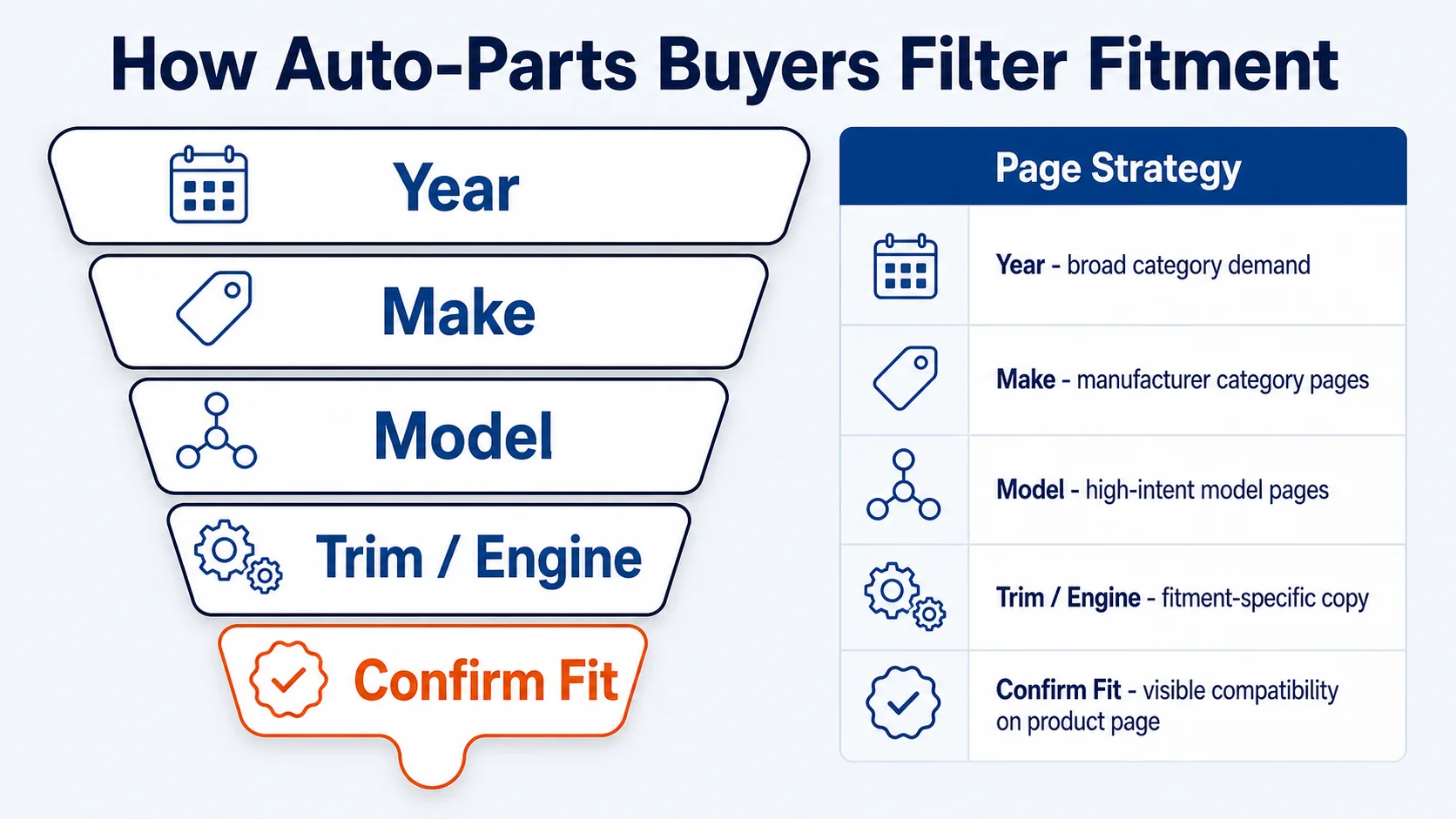
That is why year, make, model, trim, engine, and placement data should not live only inside a closed widget. If fitment is essential to the purchase, make the important compatibility information visible and crawlable on the page where it supports the buyer.
Good auto-parts pages answer questions like:
- Does this fit my vehicle?
- Is it for the front or rear?
- Is it left side, right side, driver side, or passenger side?
- Is it OE, OEM, aftermarket, refurbished, remanufactured, or universal fit?
- What trim, engine, or production-date exception changes compatibility?
Make/model coverage should also guide your keyword research. eCommerce keyword research for auto parts needs to separate broad category demand from vehicle-specific demand. A category page may target “brake pads,” while a fitment-focused page or product set may support searches tied to a specific vehicle family.
Be careful with scale. Creating a thin page for every possible year/make/model/part combination can create crawl and quality problems. Build pages where there is real demand, real inventory, and enough useful content to help the buyer.

5. Create Category Pages for Search Demand, Not Every Filter Combination
Auto-parts category pages can rank for durable demand: brake pads, rotors, floor mats, towing accessories, lift kits, performance exhaust, LED headlights, tonneau covers, and similar part families. Those pages deserve clear copy, stable URLs, crawlable product grids, internal links, and filter paths that make sense.
The trap is letting every filter combination become a search page. A year/make/model selector, fitment filter, brand filter, price range, sort order, and session parameter can create near-infinite URLs if the platform is not controlled. Many of those URLs do not deserve indexation.
Google’s ecommerce URL guidance warns that poor URL structures can cause duplicate crawling, missed content, or crawl paths that look endless. For auto-parts stores, the common risks are:
- Temporary session or tracking parameters in internal links.
- Sort-order URLs indexed as if they are unique categories.
- YMM combinations with no inventory or no unique content.
- Fitment filters that create thousands of near-duplicate pages.
- Product grids that require JavaScript clicks instead of crawlable links.
Create indexable pages for stable demand. Keep filter URLs controlled when they are only a browsing tool. Use consistent canonical URLs, sitemaps, and internal links. If a paginated category needs multiple pages, give each page a unique URL and follow eCommerce pagination guidance rather than hiding the rest of the catalog behind a button Google may not follow cleanly.
6. Use Compatibility, Similar Parts, and Internal Links to Save the Sale
The sale is not always lost when the exact part is unavailable. A buyer may accept an aftermarket replacement, compatible part, universal accessory, superseded part, or related product if the site explains the option clearly.
The old article made this point well: if you earned the click, do not strand the buyer on a dead-end product page. Give them a path to the next useful choice.
Useful internal links can include:
- “Also fits these vehicles.”
- “Replaces these OE numbers.”
- “Compatible with these models.”
- “Often purchased with.”
- “Related repair parts.”
- “Aftermarket alternatives.”
- “Superseded by.”
- “Out of stock? View compatible replacements.”
Accuracy matters. Do not imply a part fits a vehicle unless your catalog data supports it. Do not use compatibility links as a way to push unrelated products. In auto parts, a bad recommendation does more than hurt conversion. It can create returns, support tickets, and trust problems.
For discontinued or temporarily unavailable parts, connect the product page to a replacement path instead of deleting the page without a plan. Our guide to unavailable product SEO explains how to think through that decision.

7. Make Product Specifications Searchable and Useful
Specifications do two jobs: they help buyers confirm fit, and they help search systems understand what the product is. For auto parts, specs often carry the purchase decision.

Useful fields may include:
- Dimensions.
- Material.
- Color or finish.
- Placement.
- Side.
- Thread size.
- Voltage.
- Bulb type.
- Towing capacity.
- Emissions notes.
- Condition.
- Warranty.
- Package quantity.
- Included hardware.
Do not bury these details in an image or PDF if they belong on the product page. A searchable specifications table is easier for buyers to scan, easier for site search to use, and easier for Google to interpret.
Product structured data can support eligible product snippets and merchant listings when the markup and page content are accurate. Google’s Product structured data documentation includes properties tied to offers, price, availability, shipping, returns, ratings, and product information. Use the fields that match the page. Do not mark up claims that are not visible or supported.
For a broader primer, see our guide to structured data and rich snippets for eCommerce websites.
Variants need the same care. Some parts have real variant relationships, such as color, finish, size, material, or side. Google’s Product variant guidance can help when each variant has its own URL, but not every auto-parts relationship is a variant. A compatible replacement, a superseded part, and a left-side/right-side pair may each need different handling.
Search Console’s shopping reports can help monitor product snippet and merchant listing issues after implementation. Search Console can explain the issue pattern, but the live page and schema should be validated before product-snippet or merchant-listing decisions are made.

8. Write Helpful Buying Content Around the Catalog
Auto-parts buyers often need context before they are ready to buy. They may know the symptom but not the part. They may know the part but not the compatibility. They may know the fitment but not the difference between OE, OEM, aftermarket, remanufactured, and refurbished.
That is where buying content supports the catalog.
Useful content can include:
- Fitment guides for a category or vehicle family.
- OE vs aftermarket comparison notes.
- Supersession explanations for replaced part lines.
- Installation difficulty notes for DIY buyers vs shop installation.
- Troubleshooting guides that connect symptoms to part categories.
- Category buying guides for brake pads, rotors, floor mats, towing accessories, lighting, or lift kits.
- Maintenance notes that explain related parts a buyer may need at the same time.
The point is to help the buyer make a safer decision, then link them back to the correct category or product set. A generic guide that never connects to the catalog will not do much. A product grid with no guidance leaves buyers guessing.
Keep this content factual. Do not invent fitment data, torque specs, replacement intervals, or part numbers. When the detail affects safety, emissions, warranty, or compatibility, it should come from your catalog source, manufacturer documentation, or a reviewed technical source.
9. Improve Speed and Mobile Product-Page Experience
Speed still belongs in an automotive SEO plan, but the old 2018 framing needs an update. Google now talks about Core Web Vitals as part of page experience, including Largest Contentful Paint, Interaction to Next Paint, and Cumulative Layout Shift.
Google’s current good thresholds are LCP at or under 2.5 seconds, INP at or under 200 milliseconds, and CLS at or under 0.1. Treat those numbers as a technical health target, not a magic ranking switch.
Auto-parts product pages can get heavy fast. Common issues include:
- Large product images.
- Fitment selectors.
- Review widgets.
- Vehicle lookup tools.
- Financing or payment scripts.
- Chat tools.
- Inventory or shipping scripts.
- Third-party apps added by platform teams.
Those features may help buyers, but they still need to load and respond cleanly. Speed matters because the buyer is often standing in a garage, at a counter, or beside a vehicle with a phone in hand. If the fitment selector is slow, images jump, or the add-to-cart button lags, the page feels risky.
Performance work should happen by template type. Category pages, product pages, fitment results, search results, and checkout steps may have different bottlenecks. Measure each one separately.

Maintain and Measure Automotive SEO by Catalog Health
Automotive SEO is not a one-time metadata project. It is maintained through catalog health.
Useful measurement views include:
- Organic sessions and revenue by category, product type, brand, and vehicle family.
- Indexed category and product counts.
- Search Console queries grouped by part number, make/model, category, brand, and symptom.
- Product snippet and merchant listing reports in Search Console.
- Out-of-stock, discontinued, and superseded-product performance.
- Core Web Vitals by template type.
- Internal search queries that show missing products, missing synonyms, or weak category labels.
The pattern matters more than one isolated metric. If part-number queries are growing but category traffic is flat, the catalog may be strong at product detail but weak at demand capture. If YMM pages are indexed but do not convert, fitment or inventory quality may be the issue. If product snippets are eligible on one template but not another, schema or visible-page data may be inconsistent.
SEO, merchandising, development, analytics, and catalog operations have to share the same facts. That is the work.
Get an Automotive SEO Audit
OuterBox works with eCommerce and automotive companies that need SEO to hold up across large catalogs, technical platforms, and changing inventory. Since 2004, our team has helped businesses connect search strategy, development, analytics, paid media, and product-page performance around the same catalog problem.
If your auto-parts site has strong inventory but weak organic visibility, start with the catalog. We can review your category structure, metadata templates, fitment coverage, product identifiers, structured data, internal links, and page-speed priorities, then help you decide what needs to be fixed first.
Learn more about our automotive SEO services or request a conversation with the OuterBox team.
Automotive SEO FAQs
What is automotive SEO?
Automotive SEO is the process of improving organic search visibility for automotive businesses. For auto-parts stores, it usually focuses on category pages, product pages, part numbers, vehicle fitment, product data, internal links, structured data, and technical performance.
How is SEO for auto parts different from normal eCommerce SEO?
Auto-parts SEO has heavier catalog-data demands. Buyers may search by part number, year/make/model, fitment, brand, replacement status, specification, or symptom. A normal product-name and category strategy is usually not enough.
Should auto-parts pages target part numbers?
Yes, when the part number is accurate and useful to the buyer. Include manufacturer part numbers, brand data, and GTINs according to Merchant Center guidance. Do not invent identifiers or use internal SKUs as manufacturer identifiers for ordinary third-party parts.
How should an auto-parts site handle year, make, and model keywords?
Use year, make, and model data where it helps buyers verify compatibility. Build crawlable pages only when there is real search demand, real inventory, and enough useful content. Do not index every empty or thin filter combination.
Do compatible parts help SEO?
Compatible parts can help when the relationship is accurate and visible. They give buyers a next step when an exact part is out of stock, discontinued, or superseded. They also improve internal linking across related product sets.
What structured data should an auto-parts product page use?
Most auto-parts product pages should start with Product structured data where the visible page supports it. Common fields include name, image, brand, offers, price, availability, shipping, returns, ratings, and identifiers when accurate.
How should auto-parts stores handle faceted navigation?
Create indexable pages for stable demand, then control filter combinations that do not deserve indexation. YMM, fitment, sort, price, and session parameters can create near-infinite URLs if the platform links to every combination.