By: Jeff Hirz
Zero click searches make SEO reporting harder because rankings, impressions, and clicks no longer move together as cleanly as they used to. A page can still rank, the buyer can still search, and the business can still be relevant, while the search result absorbs more of the first interaction.
That does not mean the buyer disappeared. It means Google changed the surface where the buyer discovers, compares, and evaluates brands.
The goal was never website clicks for their own sake. The goal was buyers. Zero-click SEO starts with that distinction: protect clicks where a visit is needed, and build visibility where the search result itself now shapes demand.
What Are Zero Click Searches?
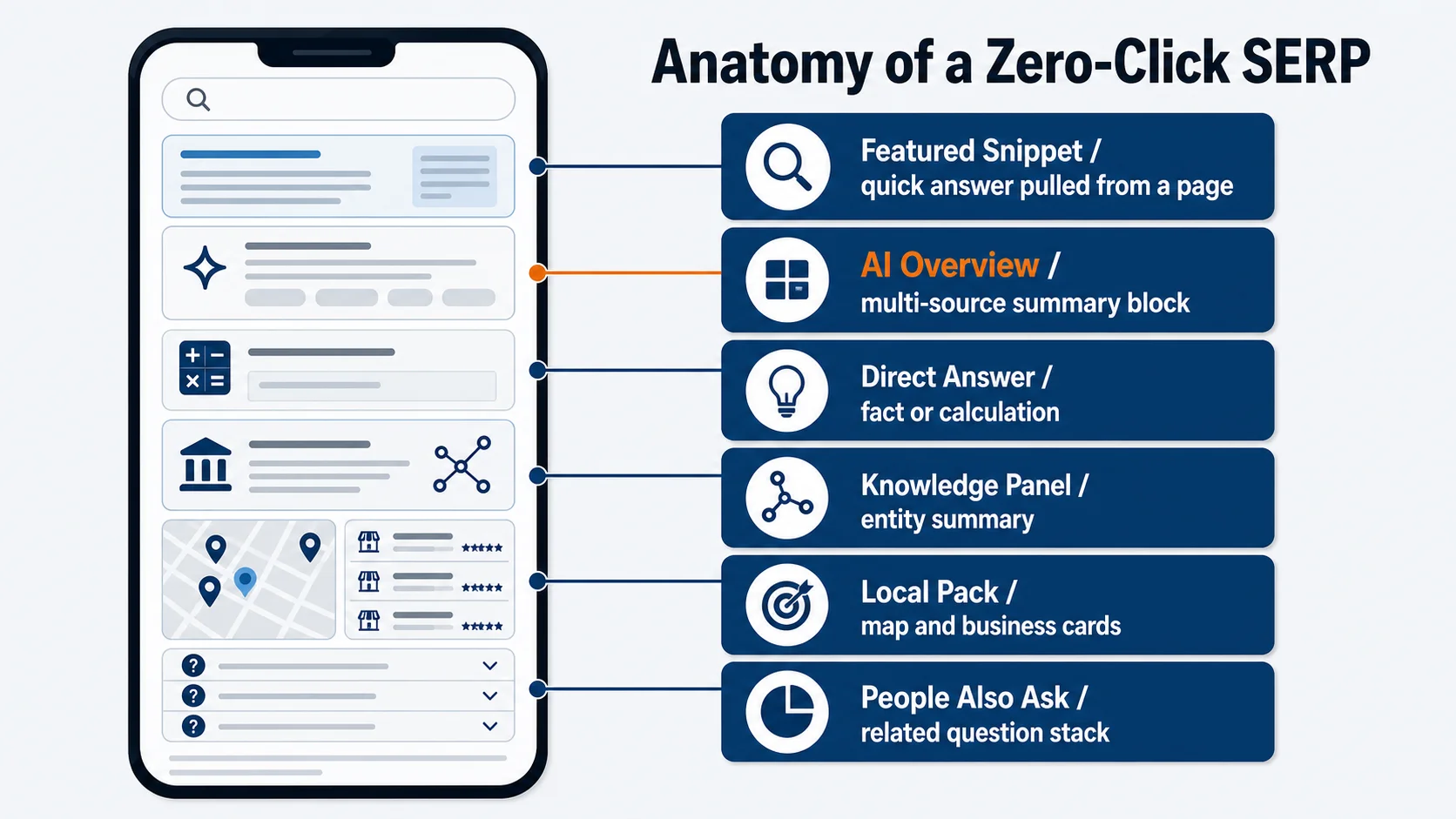
Zero click searches happen when someone gets enough information from the search results page that they do not click a traditional organic result. The answer may come from a featured snippet, AI Overview, direct answer, knowledge panel, local pack, People Also Ask result, or another search feature.
A zero-click search is not automatically a failed search. A user may find a quick answer and leave. They may refine the query. They may compare brands inside the result, come back later through a branded search, call a local business, visit a marketplace, or ask an AI tool a follow-up question.
That is why zero-click SEO needs a better diagnostic than “traffic went down.” The useful question is: did search demand go away, or did the search result change how that demand shows up?
For many businesses, the second answer is more accurate. Buyers are still looking for products, services, providers, pricing, comparisons, use cases, and proof. The search page now gives them more information before they click.
Why Zero Click Searches Changed SEO Measurement
Zero click searches changed the relationship between visibility and traffic. Ten blue links used to make the reporting story easier: improve rankings, win more clicks, measure conversions. SERP features, AI Overviews, map packs, shopping results, and answer boxes made that path less direct.
SparkToro’s 2024 zero-click study found that 58.5% of American Google searches resulted in no click. The same study also separates session endings from query changes, which matters. Some users stop. Others keep searching with a different phrase. That second behavior still shows demand, even if the first query did not send a visit.
Pew Research looked at Google searches with AI summaries in March 2025 and found that users were less likely to click traditional result links when an AI summary appeared. Pew also found that around one in five searches in its sample produced an AI summary. That supports what many SEO teams are seeing in their own data: rankings can hold while click-through rate softens.

Semrush’s zero-click study, while older and pre-full-AI-Overview-era, is still useful for one reason: it shows how often search behavior includes refinement. Semrush found that 27.6% of searches eventually undergo some kind of query refinement. A no-click query is not always the end of the buyer’s path.
Google Search Console adds another measurement challenge. Google’s AI features documentation says traffic from sites appearing in AI features is included in overall Search traffic in Search Console. Google also says there is no special schema.org structured data required to appear in AI Overviews or AI Mode. That means marketers should not pretend they can cleanly isolate AI Overview traffic in GSC, and they should not chase fake “AI markup” shortcuts.
The reporting job is more nuanced now. Search teams need to explain where clicks still matter, where visibility matters, and how both connect back to buyer demand.
The SERP Features That Create No-Click Behavior
Google search results include more answer surfaces than a traditional organic listing. Each one can reduce clicks for certain queries, but each one can also expose a brand before the buyer reaches a website.
Featured snippets pull a short answer from a webpage and display it near the top of the search result. Featured snippets can satisfy quick-answer searches, but they also cite a source and can attract clicks from users who need more depth.
Direct answers provide facts, dates, calculations, definitions, or simple reference answers without always requiring a source click. These are usually poor click targets, but they can still influence how Google understands an entity or topic.
People Also Ask boxes show related questions with expandable answers. PAA results often support follow-up research. A buyer may not click the first result, but the questions reveal what they still need to understand.
Knowledge panels summarize entities such as companies, people, places, brands, and products. They are important for entity trust, branded search, reputation, and local discovery.
Local packs and map packs give users business options, reviews, hours, location data, calls, directions, and website links. A local pack may create a no-click website session while still producing a call, direction request, or store visit.
AI Overviews and AI Mode summarize information from multiple sources and often include supporting links. Google’s own AI Overview documentation describes AI Overviews as snapshots of key information. For marketers, the practical question is bigger than the AI Overview click. It is whether the brand is present when the buyer compares options.

OuterBox sees this pattern in its own sales context. We like when an SEO service page ranks for a relevant search. But if AI recommends a shortlist instead, we also want OuterBox named in that shortlist. Many of the levers overlap: clear service positioning, strong entity signals, useful content, proof near claims, internal links, and pages that answer buyer questions without drifting into fluff.
AI Overviews Changed The First Touchpoint
AI Overviews changed zero-click SEO because they can combine the job of several older SERP features: definition, summary, comparison, source routing, and follow-up prompt. The buyer may learn enough to narrow the field before visiting any site.

Google says the best practices for SEO remain relevant for AI features, and that there are no additional requirements to appear in AI Overviews or AI Mode. That matters because it pushes the work back to fundamentals: helpful content, crawlable pages, clear entities, strong source support, and pages that satisfy the query.
AI Overview visibility is not a separate magic layer. It is a reason to make important passages easier to understand, cite, and trust.
For example, a product category page should still help buyers compare options. A service page should still explain who the service is for, what problem it solves, and why the provider is credible. A guide should still answer the question directly, then route the reader toward the next useful step. The difference is that those answers may now be read, summarized, or cited before the buyer reaches the website.
This is where generative engine optimization and AI SEO services overlap with traditional SEO. The goal is not to manipulate AI results. The goal is to make your brand, pages, claims, and proof easier for search systems and buyers to connect.
When To Chase The Click And When To Chase Visibility
Zero click searches should not all get the same response. Some queries deserve a click-recovery plan. Others are better treated as visibility, citation, or demand-shaping opportunities.
| Query or SERP condition | Primary goal | SEO move | Measurement signal |
|---|---|---|---|
| Commercial, comparison, product, pricing, service, or complex problem query | Earn the click | Improve page intent, title tag, meta description, internal links, proof, and conversion path | GSC clicks and CTR, GA4 conversions, CRM lead quality, revenue |
| Definition, quick fact, simple how-to, PAA, or answer-box query | Earn visibility and entity association | Write concise answer passages, connect the answer to a deeper resource, clarify the entity, and use visible structured data where appropriate | Impressions, SERP feature presence, branded searches, assisted visits |
| AI Overview or AI Mode query with source citations | Earn citation and qualified downstream visits | Put proof close to claims, write source-backed passages, use original examples, and link to deeper buyer pages | AI citation checks, branded query growth, landing-page engagement, assisted conversions |
| Local or near-me query with map pack prominence | Drive action without requiring a site visit | Strengthen location pages, Google Business Profile data, reviews, local content, and service/category clarity | Calls, direction requests, local rankings, form fills, booked appointments |
| Query with high impressions but declining CTR | Diagnose the SERP layout change | Compare current SERP composition against historical CTR and rewrite snippets around remaining click intent | GSC query/page/device splits, manual SERP notes, title/meta tests |
| Branded or category query where AI or SERP features compare providers | Influence the shortlist | Strengthen entity signals, proof, reviews, case studies, service clarity, and third-party consistency | Branded demand, shortlist presence, direct visits, sales-call mentions |
This table is the core shift. Zero-click search is not a reason to stop SEO. It is a reason to stop judging every query by the same metric.
A simple informational query may not need a visit to create value. A buyer who sees your brand explain a concept today may come back through a branded search tomorrow. But a commercial category query, comparison query, or service query still needs a page that earns the click and converts the visit.
How To Optimize For Zero-Click Search Without Losing Buyers
Zero-click optimization should make the buyer path clearer, not thinner. If the only plan is to answer a question in fewer words, the page may win visibility and lose the chance to move a buyer forward.
Start by separating page types:
- Service pages should prove fit, depth, process, and outcomes.
- Category and product pages should help buyers compare options and choose.
- Articles should answer the question, then connect the answer to the next useful page.
- Local pages should support map-pack visibility and real local actions.
- Case studies should give proof that search visibility can connect to revenue, leads, or qualified demand.
OuterBox’s technical SEO work often starts with the foundation: crawlability, indexation, schema that matches visible content, internal links, structured page templates, and clean site architecture. Those pieces help classic rankings and modern AI visibility because they make pages easier to understand.
Content still matters, but the content has to be specific. Featured snippet and AI Overview candidates need subject-first passages that answer a clear question. Product and service pages need proof, not generic claims. Articles need internal links that route readers toward the next useful step.
OuterBox’s Soccer Innovations work is a good example of the pattern. Content built around soccer ball sizing and buyer questions began showing in AI Overviews. The broader organic program also sustained 17% year-over-year organic revenue growth and 859 page-one keyword rankings in 2025. The lesson is not that one content format guarantees AI visibility. The lesson is that answer-ready content can support visibility and buyer demand when it is tied to real product decisions.
An anonymized home gym and fitness brand shows a related pattern. Technical cleanup, schema, product collection organization, and internal linking helped the brand appear in search features, AI Overviews, and ChatGPT citations while organic revenue rose 118%, organic shopping revenue rose 2,051%, and top-three rankings increased 69%. Those outcomes came from a broader SEO program, not a single zero-click trick.
Weiss-Aug offers a B2B example. OuterBox considered zero-click results such as AI Overviews while improving query visibility for manufacturing terms, and organic search became responsible for 66% of leads. B2B buyers often research quietly before contacting sales, so visibility inside the search result can influence later conversations even when the first click is delayed.
How To Measure Zero-Click Search Impact
Zero-click measurement should start with the buyer path, then work backward into SEO data. Rankings, impressions, clicks, and conversions all matter, but they answer different questions.
Use Google Search Console to find queries and pages where impressions or average position hold while clicks and CTR decline. A deeper look at organic click-through rate by ranking position can help separate normal CTR movement from SERP-feature disruption. Split by device when possible, because mobile SERPs often show more features above traditional organic results. Add manual SERP notes for priority queries so the data has context: AI Overview present, featured snippet present, map pack present, shopping block present, PAA expanded, or brand named in a summary.
Use GA4, CRM, call tracking, ecommerce revenue, and lead-quality data to judge the business impact of lower organic clicks. A page can lose low-intent visits while preserving or improving qualified leads. The reverse can also happen, which is why conversion and revenue data matter.
Use rank tracking or manual checks for SERP feature presence, but keep the limits clear. Google Search Console does not give a clean AI Overview report. AI citation visibility can vary by location, account, query phrasing, and timing. Treat checks as directional evidence, not a perfect truth set.
Measure supporting signals:
- Branded search growth after broader nonbrand visibility improves.
- Direct traffic or return visits after educational content gains visibility.
- Assisted conversions from content that introduces a buyer to the brand.
- Local calls, direction requests, and profile actions.
- Sales-call language that mentions AI summaries, comparison lists, snippets, or specific articles.
This is also where analytics and CRO belong in the same conversation as SEO. If the buyer still reaches the site later, the landing page has to turn that visit into a lead, sale, call, or next step.
What OuterBox Looks For In A Zero-Click SEO Plan
OuterBox looks for signs that search demand still exists, then diagnoses how the SERP changed the path from search to buyer action. The question is not “how do we get every click back?” The better question is “where did the buyer’s decision move?”
A strong zero-click SEO plan usually includes:
- Query groups split by click intent, visibility intent, and local/action intent.
- SERP feature notes for priority terms.
- Page-level diagnosis for high-impression, low-CTR queries.
- Better title tags and meta descriptions where clicks still matter.
- Answer-ready passages for featured snippets, PAA, and AI Overview citation potential.
- Stronger internal links from informational content to buyer pages.
- Entity and proof cleanup across service pages, case studies, profiles, and third-party references.
- Reporting that ties rankings, visibility, traffic, leads, calls, revenue, and sales feedback together.
OuterBox’s content marketing team and SEO team have to work from the same map. A blog post can earn visibility, but it should still support a service page, product category, case study, or conversion path. A service page can rank, but it should also be clear enough to be cited, compared, and trusted before the buyer clicks.
Zero-click search is not permission to chase vanity visibility. It is a prompt to build a better connection between how buyers search and how your brand appears.
If your rankings still look decent but organic revenue, leads, or click-through rate changed, start with the diagnostic. The buyers may still be there. The search result may simply be making them evaluate you before they arrive.
FAQs About Zero Click Searches
Are zero-click searches bad for SEO?
Zero-click searches are not automatically bad for SEO. They can reduce traffic for some queries, but they can also create brand visibility, local actions, AI citations, and later branded demand. The right response depends on the query’s job: earn a visit or influence the buyer inside the result.
How do AI Overviews affect SEO traffic?
AI Overviews can reduce clicks on some traditional organic listings because users get a summary before choosing a source. Google says AI feature traffic is included in overall Search Console traffic, so SEO teams should pair GSC data with SERP notes, citation checks, analytics, and lead or revenue data.
How do you optimize for zero-click searches?
Optimize for zero-click searches by matching the query’s job. Use concise answer passages for quick-answer queries, strengthen buyer pages for commercial queries, improve entity clarity, add structured data that matches visible content, and connect informational content to deeper service, category, or product pages.
Should you block snippets or AI Overviews?
Blocking snippets or limiting previews can reduce how Google shows your content, but it may also reduce visibility and citation opportunities. Most businesses should diagnose query value first. If a query influences buyers, appearing in the result may be more useful than hiding from it.
What should you measure besides clicks?
Measure impressions, CTR changes, SERP features, branded searches, AI or snippet citations, local actions, assisted conversions, lead quality, revenue, and sales feedback. Clicks still matter, but zero-click SEO needs signals that capture buyer influence before and after the site visit.