By: Adam Littell
The best link building strategies do not start with a list of targets. They start with a standard for saying no.
That standard matters because almost every risky link pitch sounds useful at first. A vendor promises quick wins. A publisher offers a paid placement with a clean-looking domain score. A competitor appears to rank with links you would never want near your brand. A prospect may even suggest buying cheap bulk links against competitors because they think negative SEO will hurt someone else first.
We refuse that kind of work at OuterBox. It creates ethical and operational risk for the client and for us. Google’s spam policies define link spam around links created primarily to manipulate rankings, and a campaign that depends on volume, disguise, or forced anchor text is building a liability before it builds authority.
A safe link is one you would still want if Google never counted it.
That test keeps the work honest. The link should put your brand on a relevant page, in front of a real audience, with a natural reason to cite your content. It should support a page that helps the reader continue the topic. It should be reportable to your leadership team without footnotes, excuses, or a future disavow project.
What Safe Link Building Means
Safe link building is the process of earning or securing relevant citations without crossing into manipulative link schemes. It is not a magic list of approved tactics. The same tactic can be safe in one context and risky in another.
A supplier profile can be useful when it helps customers find authorized partners. It becomes risky when the only purpose is passing ranking credit through a network of thin pages. A guest contribution can be legitimate when it gives an audience useful expertise. It becomes risky when the article exists only to carry an exact-match anchor back to a commercial page. A sponsorship can support a real event or organization. It needs proper link qualification when money, goods, or services are involved.
Google’s link best practices also point toward plain, user-first execution: links should be crawlable, anchor text should be descriptive, and the surrounding context should help people understand where the link goes. That is a useful practical standard. If the anchor would look strange to a reader, it is probably strange for SEO too.
When I’m pressure-testing a link program, I keep coming back to four questions:
- Would an editor or site owner cite this page for a real reason?
- Does the linking page overlap with our topic, audience, or market?
- Is the anchor text natural in the sentence where it appears?
- Is the target page strong enough to deserve more authority?
Those questions keep the program connected to quality. They also separate durable link building techniques in SEO from shortcuts that look efficient only on a spreadsheet.
Start With A Refusal Policy
A refusal policy is a written standard for the links your team will not build. It protects the campaign from pressure, especially when rankings are flat, competitors look aggressive, or a vendor is paid by placement count.
Your refusal policy should reject:
- Paid links that pass ranking credit without
rel="sponsored"orrel="nofollow". - Placements on sites with no real topical connection to your business.
- Pages with thin content, spun copy, or suspicious outbound-link patterns.
- Guest posts written around forced exact-match anchors.
- Low-quality directories, bookmark sites, profile links, and automated link drops.
- Sitewide footer, template, and widget links built for SEO value.
- Excessive reciprocal exchanges where the relationship exists only for links.
- Bulk link packages with unclear publisher lists or recycled inventory.
The policy should also reject target pages that are not ready. If a service page is thin, a category page lacks useful copy, or a technical issue blocks crawl and indexation, new links may do little. In that case, technical SEO, content updates, or conversion improvements may need to come before outreach.
This is where I see most programs drift. Teams keep asking “Can we get a link?” when the better question is “Should this link exist?” A refusal policy puts the second question first.
The Safe Link Building Scorecard
Use a scorecard before outreach, during publisher review, and again before a placement is approved. It does not need to be complicated. It needs to be consistent.
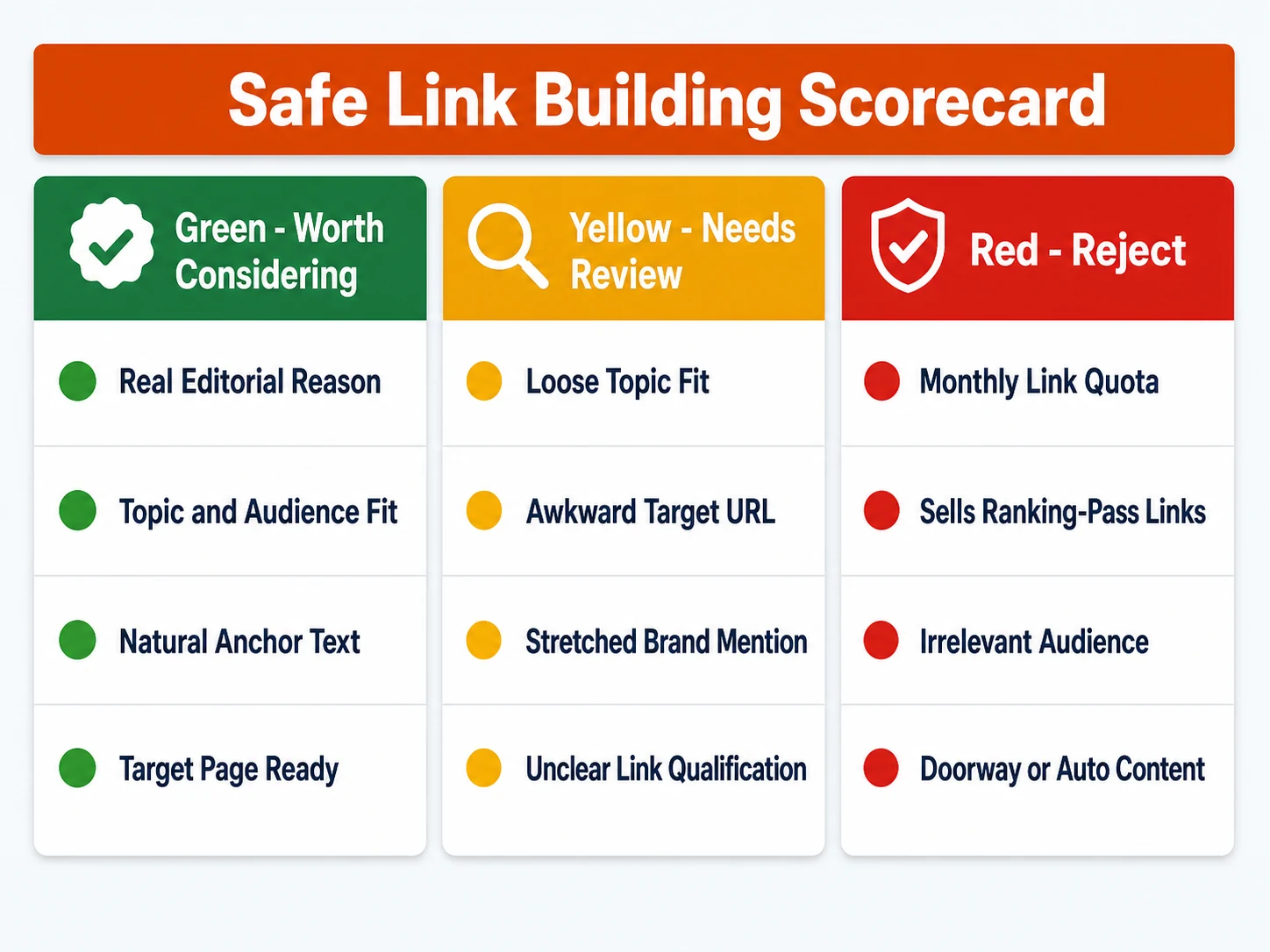
Green flags mean the opportunity is worth considering:
- The page has a real editorial reason to cite your asset, quote, data, guide, or product information.
- The topic and audience overlap with your market.
- The link target helps the reader continue the same subject.
- The anchor text is natural, concise, and not overloaded with keywords.
- Any sponsorship, advertising, sample, or paid relationship is properly qualified.
- The linking page has real content, indexation, and audience signals.
- The target page is useful enough to receive authority.
Yellow flags mean the opportunity needs review:
- The publisher is legitimate, but the topic fit is loose.
- The page is useful, but the requested target URL would feel awkward.
- A brand mention exists, but asking for a link would stretch the context.
- A sponsorship or partner relationship is real, but link qualification needs to be handled clearly.
Red flags mean the opportunity should be rejected:
- The pitch depends on a monthly link quota.
- The site sells paid links that pass ranking credit.
- The page is irrelevant to your audience.
- The article contains obvious keyword anchors for unrelated businesses.
- The publisher uses thin guest posts, doorway pages, or automated content at scale.
- The site appears to exist mainly to sell outbound links.
This scorecard gives your team a shared language. A placement is no longer “good” because a metric looks high. It is good when relevance, editorial value, anchor context, link qualification, publisher quality, and target-page readiness line up.
Build Assets Worth Linking To Before You Pitch
Most companies want links to commercial pages. Most publishers prefer to cite useful resources. The gap between those two facts is where a lot of link building fails.
The fix is to build linkable assets first, then use internal links to route authority toward pages that can rank and convert. Ahrefs explains this model in its link building guide: links often point more naturally to helpful assets, while internal links help pass equity to important commercial pages.
That asset can take many forms:
- Original data, benchmark reports, surveys, and statistics pages.
- Buying guides that explain how to choose a product or service.
- Calculators, templates, checklists, and practical tools.
- Technical references for specs, standards, materials, or regulations.
- Expert commentary that journalists can cite.
- Comparison resources that help buyers make a decision.
- Case studies with specific, defensible outcomes.

OuterBox’s Rapid Rivets work is a good example of asset-first thinking in a B2B industrial market. The site needed content aligned with how aerospace, military, and commercial buyers searched. OuterBox built intent-focused product pages around brands, specifications, materials, industries, and product types. The program produced 6,441 visits to net-new content pages and 54 new product-request opportunities in the first six months, including leads from Boeing and Northrop Grumman.
I’m not claiming every content page earns links on its own. What I am saying is that’s the foundation a safer authority program needs: useful pages that match real buyer language. Without it, outreach has to work way too hard.
Link Building Tips That Still Work
The tips below are safe only when they pass the scorecard. I treat them as opportunity types that still need judgment, not a checklist you can run blind.
Competitor backlink gaps. Review which pages earn links for competitors, then ask why those links exist. Look for patterns: data assets, category guides, resource pages, partner mentions, reviews, local coverage, or expert quotes. The goal is not to copy every backlink. The goal is to find the kinds of sources and assets your market already cites.
Unlinked brand mentions. If a publication, partner, supplier, association, or customer already mentions your brand, a link request may be reasonable. Keep the request tied to reader usefulness. “Can you link our name to the relevant resource?” is stronger than pushing a keyword-rich anchor into an old sentence.
Broken link replacement. Broken-link outreach works when your page is a true replacement for the dead source. It fails when the replacement is only loosely related. Before pitching, confirm the old page’s topic, the linking page’s context, and whether your asset solves the same reader need.
Digital PR and expert commentary. Journalists, analysts, newsletter writers, and niche publishers need sources with credible expertise. Useful commentary can earn citations, brand mentions, referral traffic, and wider visibility. It can also support AI and agentic search visibility as those systems look for credible references across the web. Treat that as a secondary benefit rather than a ranking promise.
Resource pages and partner pages. Associations, distributors, vendors, chambers, schools, nonprofits, and industry groups often maintain useful resource lists. These links can be safe when the relationship is real and the page helps its audience. They become risky when the page exists only to trade links or sell inclusion.
Original data, tools, and checklists. Data-backed assets give writers a reason to cite you. Practical tools and checklists give educators, consultants, and trade publications something useful to share. A good content marketing program should identify which assets your audience would actually reference.
Events, webinars, podcasts, and interviews. Speaking, sponsoring, and contributing can earn legitimate links when the event or publisher is relevant. If compensation or sponsorship is involved, qualify the link correctly. The value should still stand without passing ranking credit: audience, authority, referral traffic, and relationship building.
Link reclamation. Reclaim links lost through site migrations, old URLs, deleted pages, or outdated references. This is often one of the cleanest opportunities because the editorial reason for the link already existed. Pair reclamation with redirect cleanup and internal-link review so authority is not wasted.
Tactics That Look Easy But Create Risk
Risky link building often sells speed. The problem is that speed usually comes from removing the steps that make a link defensible.
Cheap bulk link buying is the clearest red flag. I once had a smart, technically sharp business owner sit across from me and argue that we should buy a stack of cheap links and point them at his competitors. His logic was that the links were obviously toxic enough to tank the other guys’ rankings, so why not use them as a weapon? I told him no. If a link is dangerous enough that you want to aim it at someone else’s site, it has no business anywhere near your own.
Avoid these shortcuts:
- Bulk guest-post packages with hidden publisher lists.
- Paid insertions on unrelated pages.
- Expired-domain networks.
- Private blog networks.
- Comment spam, forum spam, and profile spam.
- Press releases written mainly for keyword anchors.
- Widget, badge, and footer links that pass ranking credit at scale.
- Exact-match anchors repeated across multiple placements.
- Directories with no editorial standards or audience value.
The issue is not that every directory, guest article, or partner mention is bad. The issue is intent and execution. A legitimate industry directory can help customers find a supplier. A thoughtful guest article can help a niche audience. A partner page can document a real relationship. When the link exists mainly to manipulate rankings, the tactic has crossed the line.
Plan Anchors, Target Pages, And Internal Links Together
Anchor text should describe the destination without looking engineered. A healthy mix usually includes brand anchors, URL anchors, topical anchors, partial-match phrases, and natural citation language. Exact-match commercial anchors should be rare and only used when the sentence truly calls for them.
Instead of asking publishers to use a specific keyword every time, plan anchor categories:
- Brand: “OuterBox”
- URL: “outerboxdesign.com”
- Topic: “link building services”
- Partial match: “safe link building plan”
- Citation phrase: “the agency’s link quality framework”
- Product or service name: a real page name when it fits naturally
Target-page planning matters just as much. A link to a page that does not satisfy the searcher may not create much value. Before outreach, review whether the receiving page has clear search intent, strong copy, internal links, schema where relevant, fast loading, accurate indexation, and a conversion path.
Then plan internal links from linkable assets to commercial pages. If a research report earns links, it can point readers toward a service page, category page, or buying guide where the next step makes sense. That internal route should feel useful to the reader and fit the topic naturally.
This is one reason link building should sit inside SEO strategy. OuterBox’s CORSA Performance work shows the value of intent-focused SEO in a competitive ecommerce market. The broader program helped CORSA increase organic search revenue by 366%, lift unbranded traffic by 31%, and gain 122 first-page rankings. Those results came from an integrated SEO and paid media strategy.
How To Measure Link Quality
A link report that only lists domain metrics and placement counts is incomplete. Domain authority, domain rating, traffic estimates, and similar third-party metrics can help with screening, but they should not make the decision for you.
Measure link quality across several layers:
- Relevance: Is the linking page topically related to your business, audience, product, or expertise?
- Editorial context: Does the link fit the surrounding copy, or does it look inserted?
- Audience value: Would a qualified reader have a reason to click?
- Publisher quality: Does the site have real content, bylines, traffic signals, indexation, and editorial standards?
- Outbound-link pattern: Does the page or domain link out naturally, or does it look like a marketplace?
- Anchor safety: Is the anchor descriptive without being forced?
- Target-page fit: Does the destination help the reader and support your SEO goals?
- Performance: Did the placement drive referral traffic, branded search, ranking movement, assisted conversions, leads, or revenue signals?

The performance layer takes time. New links may be crawled, indexed, and evaluated gradually. Early signs can include placement indexation, referral visits, target-page ranking movement, and growth in referring domains. Business impact may show later, especially in competitive markets.
For ecommerce and lead-generation brands, connect link reporting to SEO audits, analytics, rankings, organic sessions, assisted conversions, and revenue where possible. Links should serve the business before they serve the backlink spreadsheet.
When A Safe Link Building Service Makes Sense
A safe link building service makes sense when your team has ranking opportunity but lacks the time, publisher research, content assets, or quality controls to run outreach well.
It can also make sense when your market is competitive enough that content alone is not closing the authority gap. Many ecommerce brands, B2B companies, manufacturers, SaaS firms, and multi-location businesses need a steady process for finding relevant publishers, building assets, earning citations, and measuring what changed.
When I’m vetting a provider, these are the questions I want answers to before anyone signs anything:
- What links will you refuse to build?
- How do you screen publishers beyond domain metrics?
- How do you handle paid, sponsored, or gifted relationships?
- How do you plan anchor text?
- How do you decide which target pages deserve links?
- Do you build or recommend linkable assets before outreach?
- How do you report link quality and business impact?
- Will you show the placement list before links go live?
If the answer is mostly about volume, guaranteed placements, or proprietary publisher inventory, slow down. Quality link building combines strategy, content, outreach, risk control, and reporting.
Lethal Performance shows why that integration matters. OuterBox’s work for the aftermarket performance parts ecommerce brand included on-page optimization, link building, content development, conversion rate optimization, technical updates, and paid search optimization. The broader program produced a 1,103% revenue increase, 456% traffic lift, and 14,213 first-page Google positions, up from 3,800. Link building was one part of a larger search and revenue engine.
Safe link building is slower than buying a package, but it leaves you with assets, relationships, citations, and authority you can defend later.
If you take one thing from this: start with the refusal policy. Build pages worth citing. Use the scorecard. Keep anchors natural. Route authority with internal links. Measure quality beyond counts. And when you need help, pick a partner who can explain the links they’ll refuse as clearly as the links they want to earn.
FAQs About Safe Link Building
What makes a link-building strategy safe?
A safe strategy earns links from relevant sources for editorially defensible reasons. The linking page should have a real audience, the anchor should fit the sentence, the target page should help the reader, and any paid or sponsored relationship should be qualified correctly.
Are paid links always unsafe?
Paid promotion, sponsorships, samples, and advertising can be legitimate marketing. The risk comes from paid links that pass ranking credit as if they were editorial endorsements. When compensation is involved, use proper qualification such as rel="sponsored" or rel="nofollow" and evaluate the opportunity for audience value beyond SEO.
How many links do I need?
There is no universal number. The right target depends on your competition, current authority, target pages, content quality, industry, and keyword difficulty. A smaller number of relevant, defensible links can be more useful than a larger number of weak placements.
Should links point to blog posts or commercial pages?
Both can make sense. Publishers often link more naturally to helpful assets, guides, tools, and data. Those assets can then internally link to commercial pages where the next step is useful. Direct links to service, category, or product pages are safest when the page genuinely helps the linking page’s audience.
Can link building help AI search visibility?
Credible citations can support broader brand visibility because search engines, AI answer systems, journalists, and buyers all rely on recognizable sources across the web. That does not make link building an AI-visibility guarantee. Treat it as a secondary benefit of earning useful mentions on relevant pages.
What is the biggest red flag in a link-building vendor?
The biggest red flag is a provider that sells links as a quota without showing the publisher list, relevance checks, target-page logic, anchor plan, or refusal policy. If the provider cannot explain what it will reject, it probably cannot protect your brand.