By: Jeff Hirz
Your website conversion rate does not improve because a team copies a small visual tweak from another site. It improves when you find the point where qualified visitors stop believing, stop understanding, or stop moving forward.
That is why conversion rate optimization is revenue protection. If your company already invests in SEO, PPC, email, social, referrals, direct demand, or brand campaigns, weak conversion paths make every visit more expensive than it needs to be. More traffic helps only after the page, form, cart, or funnel can turn that traffic into real business outcomes.
Most CRO wins start by finding the moment where a qualified visitor loses confidence.
The 11 ways below are built around that idea. Each one maps to a specific conversion leak, so you can improve website conversion rate by fixing the highest-value problem first instead of testing random changes.
If you want the broader definition before the tactical list, start with what conversion rate optimization means. If you are ready to diagnose the page in front of you, start here.
1. Define The Conversion Event Before You Change The Page
Before changing a headline, CTA, form, layout, or checkout step, decide which action actually matters. A conversion might be a purchase, quote request, phone call, booked consultation, lead form submission, demo request, application, add-to-cart event, or cart-to-checkout progression.
The conversion rate formula is simple:
Conversion rate = conversions / visitors or sessions x 100.
If 10,000 visitors reach a landing page and 300 submit the form, the conversion rate is 3%. If 2,000 shoppers reach the cart and 900 continue to checkout, that cart-to-checkout progression rate is 45%.
The formula is only useful when the numerator matters. Google Analytics uses key events for actions that are important to business success. CRO should start with the same discipline. A loose form submission that never becomes a qualified lead may look good in analytics and still waste sales time. A product-page click may be useful for diagnosis, but it is not the same as revenue.
Pick the business event first. Then compare changes against that event and the quality signals behind it, such as revenue per visitor, average order value, qualified lead rate, close rate, cost per acquisition, or repeat purchase behavior.
Set the baseline before the first change. Pull at least enough history to see normal weekly swings, device differences, and source differences. A landing page that converts cold paid traffic at 2% and branded email traffic at 12% does not have one simple conversion problem. It has different audiences entering with different levels of intent.
2. Make The Value Proposition And Next Step Obvious
Visitors should know what you offer, who it is for, why it is worth their attention, and what to do next without assembling the page like a puzzle.
For ecommerce pages, that means clear product naming, useful product copy, pricing, shipping expectations, delivery timing, returns, reviews, and a visible purchase path. For lead-generation pages, it means a specific offer, a form or phone path that fits the buying stage, and copy that explains what happens after the visitor acts.
This does not mean every page needs one giant CTA. It means the page should have a clear primary next step and fewer distractions competing with it. A category page might route users to product filters. A service page might route to a consultation. A long-form article might route to a related guide or a diagnostic service page only after it has answered the query.
If the goal is not clear, the visitor has to make too many decisions. Conversion rate optimization starts by reducing that uncertainty.
3. Match The Page To Visitor Intent
| Traffic Source | Typical Intent | What They Need First | Right Next Step |
|---|---|---|---|
| Organic search | Research and learn | Clear answers and proof | Route to a deeper guide or diagnostic page |
| Paid search | Buy, quote, or book | The exact offer that matched the ad | Show the offer above the fold, fast |
| Email campaign | Continue a campaign story | Pickup of where the email left off | Resume the campaign’s promised next step |
| Returning visitor | Take action they already considered | Less introduction, faster access | Direct path to the conversion event |
A page can be well designed and still fail if it answers the wrong moment in the buyer journey.
Organic visitors may arrive from an informational query and need comparison, education, or proof before they are ready to talk. Paid visitors may click an ad that promises a quote, trial, demo, discount, or specific product category. Email visitors may expect continuity from a campaign message. Returning visitors may need fewer introductions and more direct access to the next step.
When page intent and traffic intent do not match, conversion rate falls for reasons that look like design problems but are really promise problems. The visitor clicked for one thing and landed on another.
To diagnose this leak, review the top queries, ad copy, email subject lines, audience segments, and entry pages that drive traffic. Then ask whether the first screen answers the promise that brought the visitor there. Matching intent protects traffic quality before you spend more to attract the next visit.
4. Shorten The Path Through Navigation And The Funnel
Visitors who are ready to move forward should not have to decode your navigation, search for the right page, or backtrack through avoidable steps.
For ecommerce sites, this can mean clearer categories, filters, product comparison, internal search, product detail page links, cart visibility, and fewer checkout distractions. For lead-generation and service sites, it can mean simpler menus, stronger service routing, visible phone/contact paths, and tool links that help visitors self-select.
OuterBox saw this in a Trinity Windows navigation test. The existing flyouts had too many links and buried useful product-selection tools. Simplifying the navigation and emphasizing helpful tools produced a 10.53% lift in phone calls, a statistically significant lift in navigation-tool interactions, and improved Perfect Match tool completion.

The lesson is not “make every nav smaller.” The lesson is to remove choices that make qualified visitors hesitate and elevate the path that helps them choose.
5. Reduce Friction In Forms, Carts, And Checkout
Some visitors want to act, but the process makes acting harder than it should be. That is one of the most expensive conversion leaks because intent is already present.
On lead-gen pages, review field count, field order, labels, inline validation, mobile keyboards, error messages, privacy expectations, and whether the visitor knows what happens after submission. On ecommerce pages, review shipping costs, delivery estimates, payment options, guest checkout, coupon fields, form validation, address entry, trust cues, and return policy visibility.
Baymard’s checkout research reports a 70.19% global average cart abandonment rate and shows why checkout usability deserves serious attention. That number does not mean every abandoned cart is fixable. Some shoppers are browsing or comparing. The CRO opportunity is in the solvable friction that blocks shoppers who were close to buying.
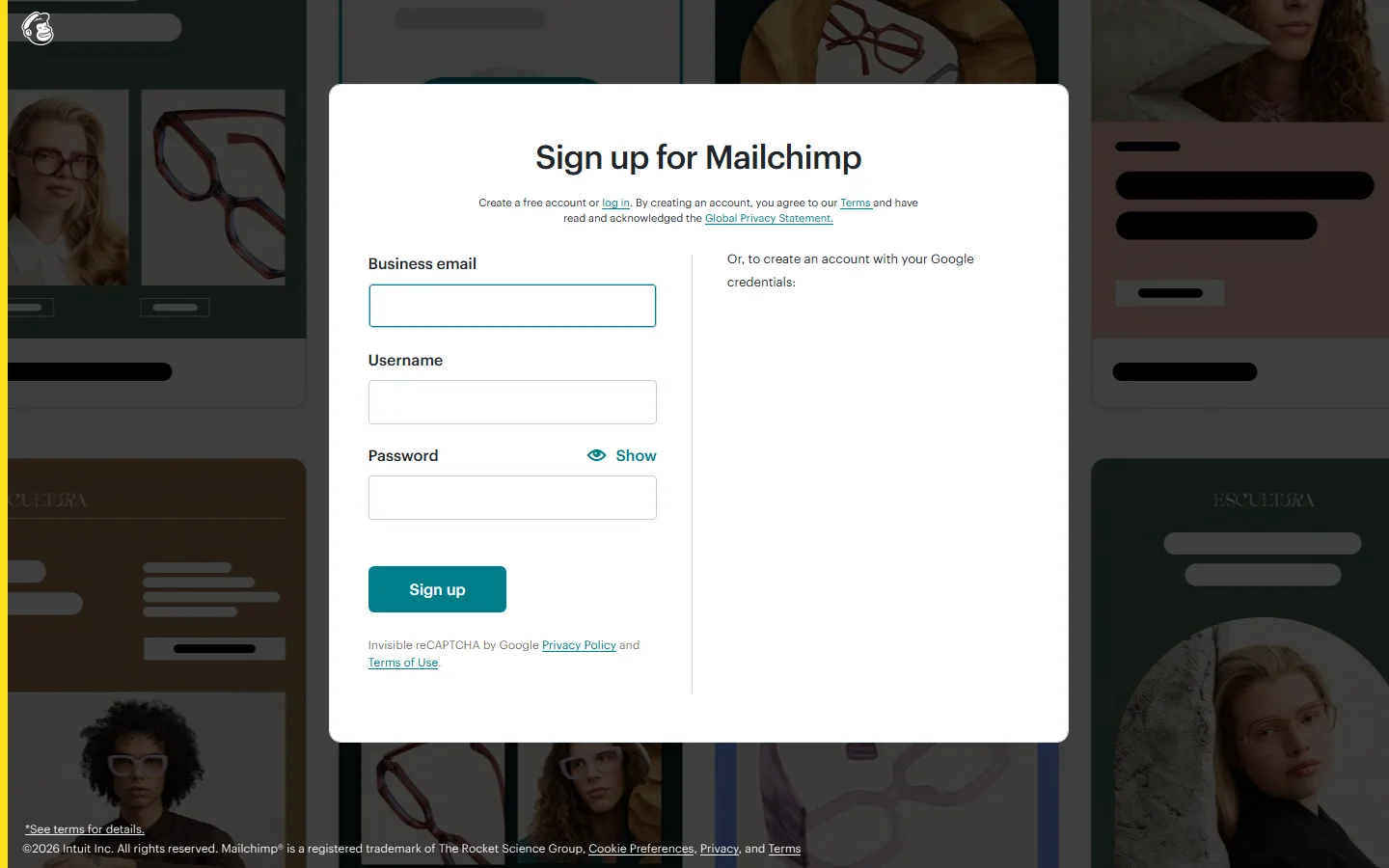
OuterBox case studies show the same pattern. For Mood Media, OuterBox simplified a lead form with a single-column layout, fewer fields, and inline validation, producing a 239% increase in lead-generation submissions. For TIE Industrial, OuterBox moved quote access into a global Quick Quote modal, producing an 85.63% increase in form submissions. For Road Ready Wheels, OuterBox improved cart pricing clarity and saw a 14% lift in cart-to-checkout progression, a 21% conversion-rate lift, and an estimated $30,700 in monthly revenue impact.
Forms and checkout paths should not be easier in the abstract. They should be easier at the exact step where a qualified visitor is trying to act.
6. Build Trust Where The Decision Happens
Trust is not a decorative row of logos at the bottom of a page. It has to appear where hesitation happens.
An ecommerce shopper may need reviews, product photos, warranty details, shipping policies, return language, secure-payment cues, or size/fit guidance near the purchase decision. A lead-gen visitor may need proof that the company understands their problem, has helped similar businesses, protects submitted information, and will respond in a useful way.
This is where testimonials, certifications, case studies, associations, review summaries, founder or team context, security language, warranty details, and policy clarity can matter. Place proof near the claim or action it supports.

AICPA Trust is a useful example. OuterBox’s personalization and confidence-building work helped increase quote starts by 70% and completed applications by 40%. The lift came from reducing hesitation around a serious decision, not from adding generic trust language to the page.
Ask what the visitor might be afraid of at the moment of action. Then put the answer where that fear appears.
Trust also changes by page type. A category page may need easy comparison and clear delivery expectations. A product page may need reviews and return policy detail. A service page may need experience, process, and proof that the team can solve the buyer’s specific problem. A form page may need privacy language and a clear explanation of who will follow up.
7. Improve Speed, Stability, And Mobile Usability
Slow, unstable, or awkward pages make visitors work harder. That effort can look like low interest in analytics even when the real issue is usability.
Google’s Core Web Vitals focus on loading performance, interactivity, and visual stability. Those are not the only user-experience metrics that matter, but they are useful starting points for finding pages that feel slow, jumpy, or hard to use.
Conversion-focused mobile checks should go beyond lab scores. Test real forms on phones. Watch how the keyboard covers fields. Check whether sticky elements block CTAs. Review tap targets, image loading, product filters, cart edits, address fields, and popups. Compare mobile and desktop conversion paths to find device-specific leaks.
Speed alone does not guarantee conversion gains. But if visitors cannot read, tap, compare, submit, or check out smoothly, every other CRO idea has less room to work.
8. Use Qualitative Data To Find The Real Objection
Analytics can show where conversion rate drops. Qualitative data helps explain why.
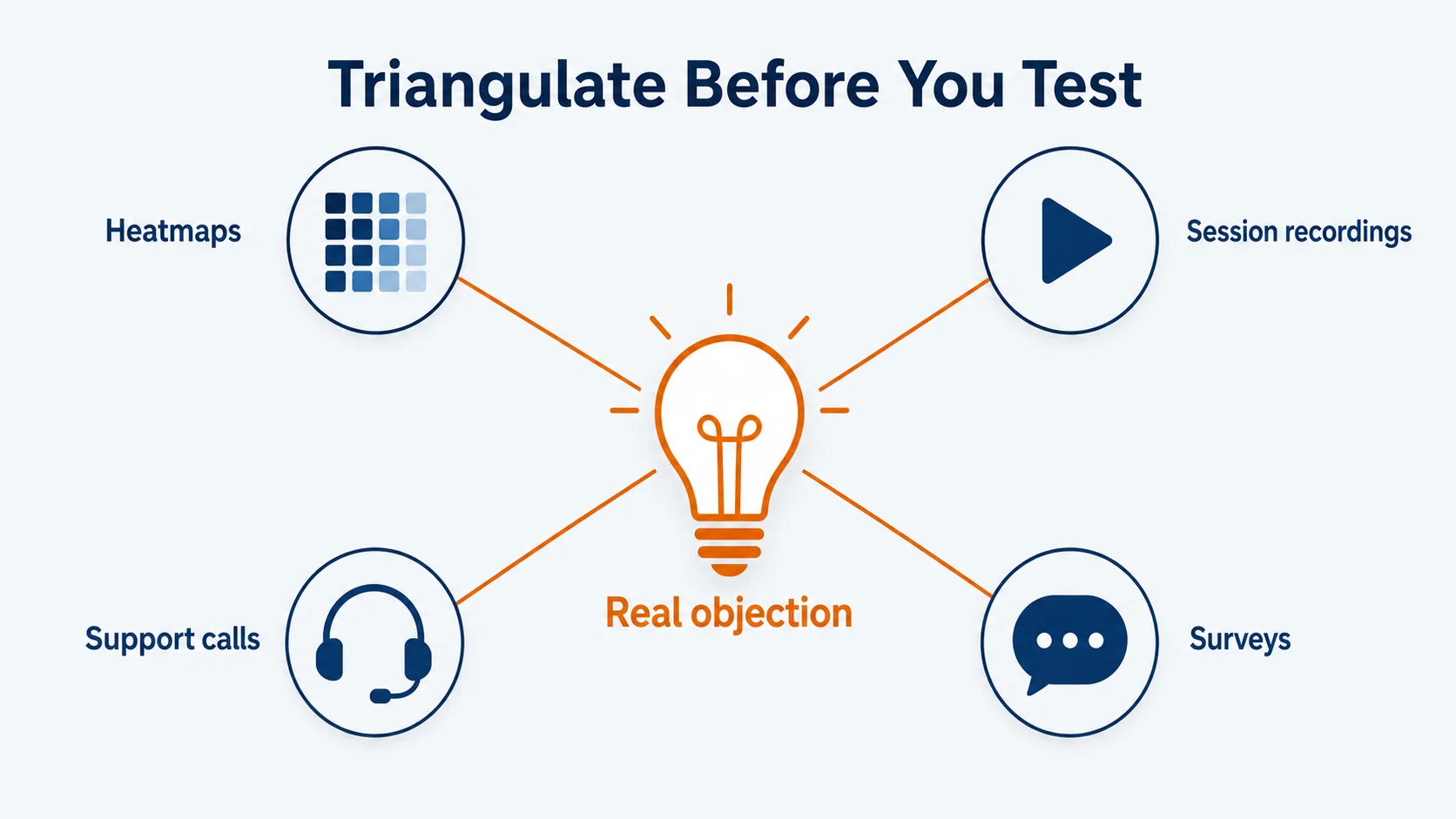
Use heatmaps, session recordings, scroll maps, form analytics, on-site surveys, user testing, customer service questions, sales-team feedback, live chat transcripts, and on-site search queries to identify hesitation. A funnel report may show that visitors abandon a quote form. A recording may show that the error message appears after the visitor thinks the form submitted. A survey may show that buyers cannot find compatibility, sizing, cost, or timing information.
This stage is diagnosis, not validation. Do not blend it with A/B testing. The goal is to understand the objection well enough to form a useful hypothesis.
For 1031 Crowdfunding, OuterBox added available properties and a clearer process overview, increasing progression to registration by 38.9%. That kind of fix starts by understanding what would make the next step feel more worthwhile.
9. Validate Changes With A/B Testing When The Data Supports It
A/B testing is valuable when the site has enough traffic and conversions to support a reliable read. It is less useful when teams test tiny changes on tiny samples and treat the winner like fact.
Optimizely’s statistical-significance documentation says binary metrics need at least 100 visitors or sessions and 25 conversions in both the baseline and variation before a winner is declared. That is a useful reminder: testing is a measurement method, not a ritual.
If your site has enough volume, test meaningful hypotheses tied to a diagnosed leak. Test an offer, form flow, checkout step, product-page layout, navigation treatment, trust placement, or landing-page message. If your site does not have enough volume, prioritize tracking cleanup, usability review, qualitative diagnosis, and obvious friction fixes. Then monitor directional changes in the business metric while you build a stronger testing base.
The mistake is not skipping an A/B test. The mistake is pretending a weak test gives a strong answer.
10. Keep SEO, PPC, Email, And Landing Pages Consistent
Conversion rate can fall when the page breaks the promise made before the click.
SEO pages should satisfy the searcher’s intent and offer a logical next step after the answer. PPC landing pages should echo the ad’s offer, audience, and urgency. Email and social landing pages should continue the campaign message instead of forcing visitors to restart. Product and service pages should align copy, visuals, proof, and CTAs around the same value proposition.
This is where CRO connects to acquisition. SEO and PPC can bring qualified visitors. CRO protects that value after the click. If an ad promises a free estimate and the landing page hides the estimate path, the problem is not just a paid media problem. If an organic article earns traffic but never routes readers to the next useful page, the problem is not just an SEO problem.
Review high-traffic entry pages by source and intent. Then make sure the page answers the reason each visitor arrived.
11. Measure Conversion Quality, Not Just Conversion Volume
More conversions are not always better. More valuable conversions are better.
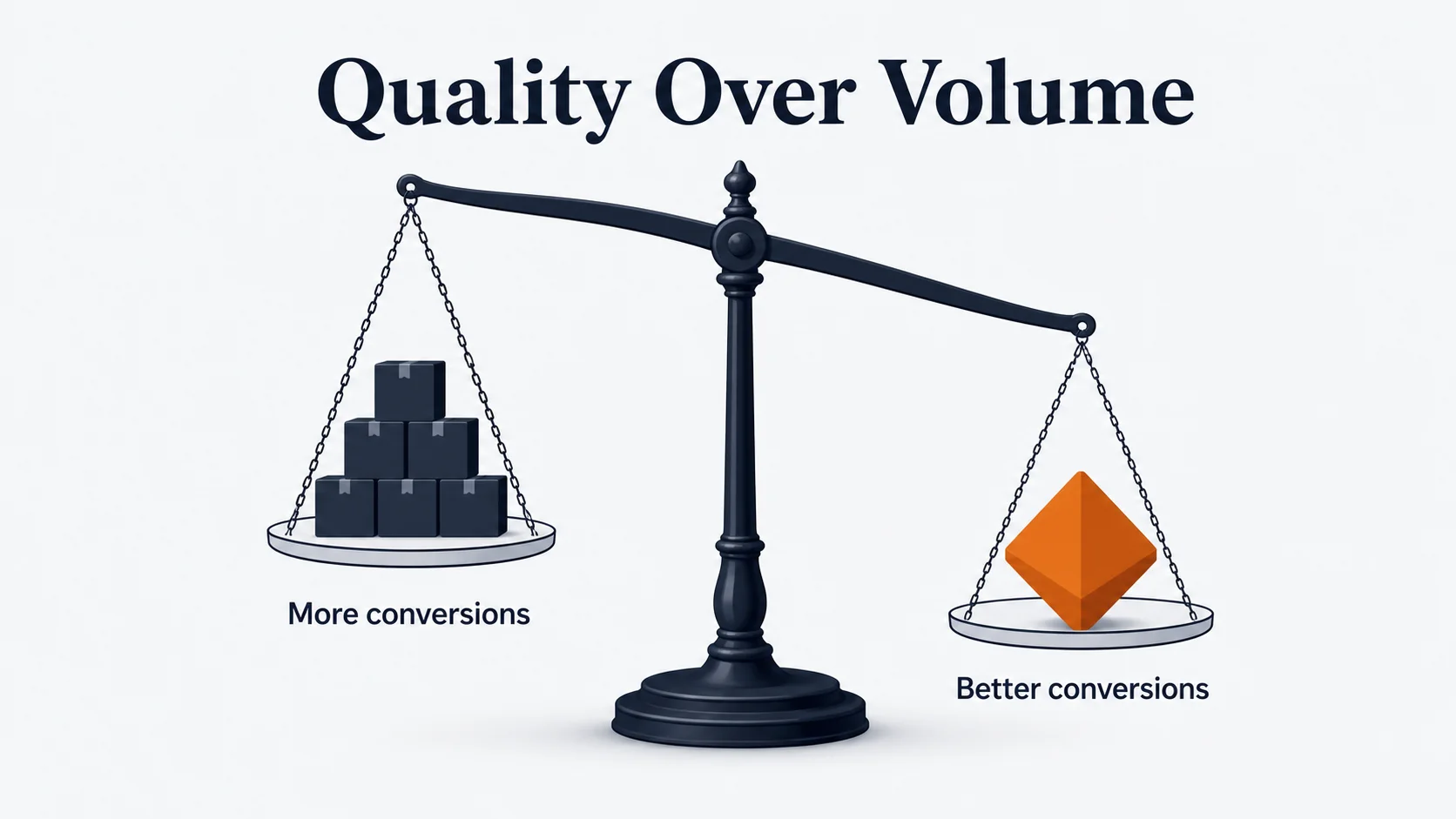
A form can convert more visitors while sending lower-quality leads to sales. A discount can increase order count while hurting margin. A checkout change can lift purchases but reduce average order value. A demo request page can generate more submissions from prospects who are not ready or not a fit.
That is why conversion reporting should include quality signals. For ecommerce, review revenue per visitor, average order value, gross margin, repeat purchase, returns, and customer lifetime value. For lead generation, review qualified lead rate, sales acceptance, close rate, pipeline value, call quality, appointment show rate, and CRM-sourced revenue.
The learning loop matters because one conversion win should inform the next page, campaign, or funnel step. CRO is not finished when the conversion count rises. It is working when the business understands which visitors, offers, pages, and friction fixes produce outcomes worth repeating.
This is also where sales and marketing need to share data. If a form change lifts submissions but sales rejects more of them, the win is incomplete. If a checkout change lifts completed orders but return rates rise, the page may be overselling. Better reporting keeps CRO tied to revenue protection instead of vanity metrics.
When To Bring In Conversion Rate Optimization Services
Bring in conversion rate optimization services when the traffic is valuable, the conversion path is underperforming, and the next fix is not obvious.
Common signs include weak or unreliable tracking, paid media spend that does not convert after the click, major mobile/desktop gaps, form or checkout abandonment, internal disagreement about what to test, and pages with enough traffic to justify a more disciplined CRO roadmap.
A CRO partner should not begin with a bag of tricks. The work should start with measurement, diagnosis, prioritization, implementation, and testing when the data supports it. For some companies, that means CRO consulting around a specific funnel. For others, it means ongoing analytics, UX, copy, development, and testing work tied to revenue goals.
OuterBox’s CRO service materials set a common expectation that many clients see noticeable movement within 60-90 days, depending on tracking, traffic volume, testing velocity, and implementation complexity. Current CRO retainers typically range from $3,000-$15,000 per month, which is why the first priority should be the highest-value leak, not a long list of low-impact tweaks.
If you need help finding that leak, start with a measurement review, page or funnel audit, and a prioritized roadmap before buying more traffic for the same conversion path.
For smaller sites, the first engagement may be a focused audit and implementation plan. For larger ecommerce or lead-generation programs, it may include ongoing testing, analytics support, UX research, copy revisions, development support, and executive reporting. The right scope depends on traffic volume, conversion value, and how quickly the team can ship changes.